Have you ever walked into a room and felt like something was missing, even though the furniture was perfect? I’ve been there! We spend hours obsessing over rugs and throw pillows, but we often completely ignore the “fifth wall”—our ceiling! It’s crazy to think that simply changing what’s above our heads can completely alter the vibe of a living space. In fact, interior designers estimate that a well-designed ceiling can make a room feel up to 15% larger and infinitely more luxurious. Whether you are dealing with a cozy apartment or a sprawling open floor plan, looking up might just be the design solution you’ve been searching for. Let’s dive into some transformative ideas that will have you grabbing a ladder and a paintbrush in no time!
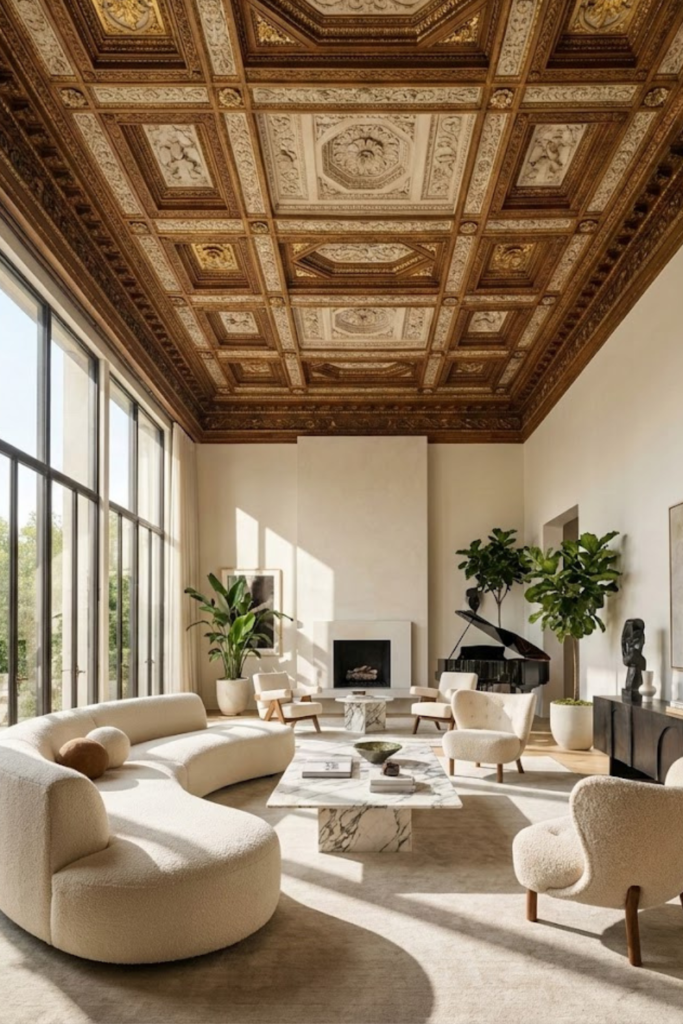
1. Embrace Rustic Charm with Exposed Wooden Beams
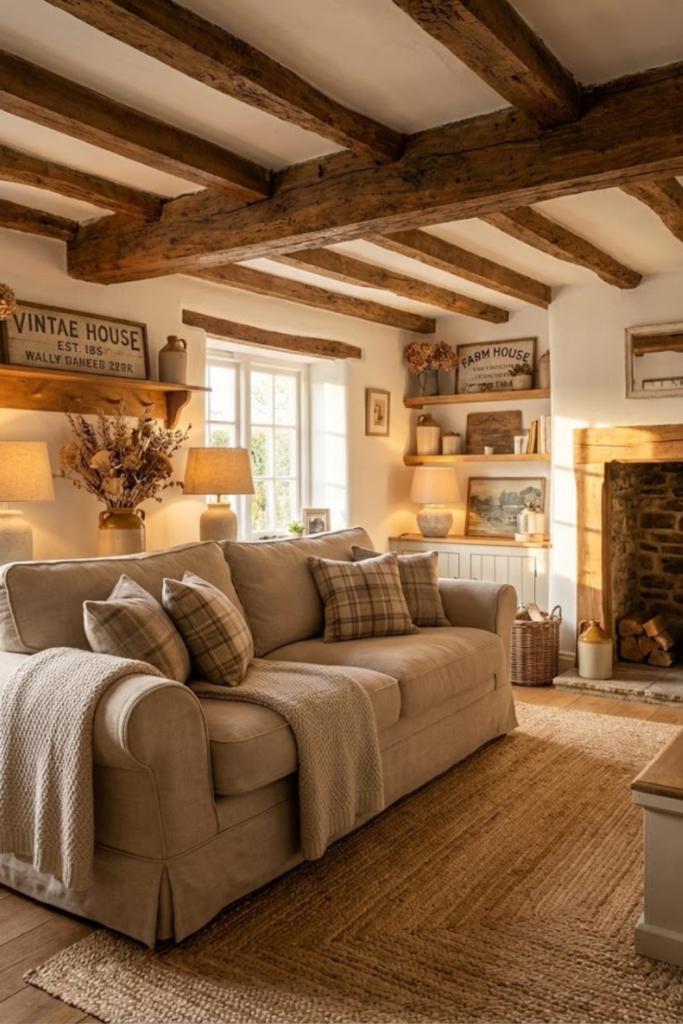
I still remember the first time I decided to tackle exposed beams in my own living room. I had this grand vision of hauling 100-year-old barn wood into the house, creating this authentic farmhouse look that would make my neighbors jealous. Spoiler alert: real wood is incredibly heavy. I nearly threw my back out trying to lift a solid oak beam, and I realized pretty quickly that I didn’t have the structural support to hold that kind of weight. It was a total disaster, and I ended up staring at a damaged drywall ceiling for two weeks out of pure frustration.
But, you live and you learn, right?
The good news is that you can get that cozy, rustic vibe without reconstructing your entire roof or breaking the bank. If you are looking for impactful living room ceiling designs that add instant character, this is probably my favorite go-to.
Real Wood vs. Faux Wood: The Truth
Here is the deal. Unless your home was built with structural timber beams exposed, you are likely adding them purely for decoration.
- Reclaimed Wood: It is beautiful, yes. But it is also expensive—often costing upwards of $1,000 per beam depending on the size—and heavy. You gotta find the joists perfectly.
- Faux Wood (Polyurethane): This was my savior. High-density polyurethane beams look scary real (my mother-in-law still thinks mine are oak) but weigh practically nothing. You can install them with construction adhesive and a few screws.
Visual Tricks That Actually Work
One thing I messed up early on was the spacing. I put them too close together, and the room felt like a cave. It was dark and felt cramped.
If you have standard 8-foot ceilings, space your beams about 4 to 5 feet apart. This spacing tricks the eye. It makes the ceiling feel wider and less cluttered. Also, running the beams perpendicular to the longest wall in a rectangular room can help the space feel more balanced. It’s a simple trick, but it works wonders.
A Quick Note on Finish
Don’t just slap them up there raw! If you go with natural wood, use a stain that contrasts slightly with your floor. I once matched them perfectly, and it looked like the floor had jumped onto the ceiling. It was too much. A slightly darker stain on the ceiling draws the eye up and creates that “wow” factor we are all chasing.
2. Add Depth Using Elegant Coffered Ceilings

Honestly, for the longest time, I thought coffered ceilings were only for fancy libraries or those huge mansions you see in movies. You know the ones—where everything looks expensive and you are afraid to touch anything? But then I helped a friend renovate her older suburban home, and she was dead set on adding these “waffle-like” grids to her living room. I was skeptical. I thought it would look too busy.
I was wrong.
When we finished, the room didn’t just look better; it looked “finished.” It added this layer of texture that made the plain drywall disappear.
What Exactly is a Coffered Ceiling?
If you aren’t sure what I’m talking about, picture a grid of sunken panels. It’s like a tic-tac-toe board on your ceiling. The beams stick out, and the squares in between are recessed (pushed in).
This style is fantastic for hiding imperfections. If your original ceiling has waves or weird bumps from years of settling, the beams cover a lot of that up. It gives the room a solid, structured feel that you just don’t get with flat paint.
The Height Rule (Please Read This)
Here is the big lesson I learned the hard way on a different project: You need height.
If your living room ceiling is barely 8 feet tall, skipping this design is probably smart. Adding heavy beams that drop down 6 inches can make the room feel like the lid is closing in on you. It gets claustrophobic fast. But, if you have 9-foot ceilings or higher? This is a game changer. It breaks up that big empty space above your head and makes the room feel cozier without sacrificing the airy feeling.
A Simple Paint Trick
Most people paint the whole thing white. That looks clean and classic. But if you want to be a little brave, try painting the inside of the “boxes” a soft grey or a shade slightly darker than the beams.
I tried this in my own dining area (which connects to the living room), and it made the white beams pop incredibly well. It highlights the architectural detail so people actually notice the work you put in. Just don’t go too dark inside the squares unless you have a ton of windows, or it might suck the light out of the room.
3. Create Height with Modern Tray Ceiling Layouts
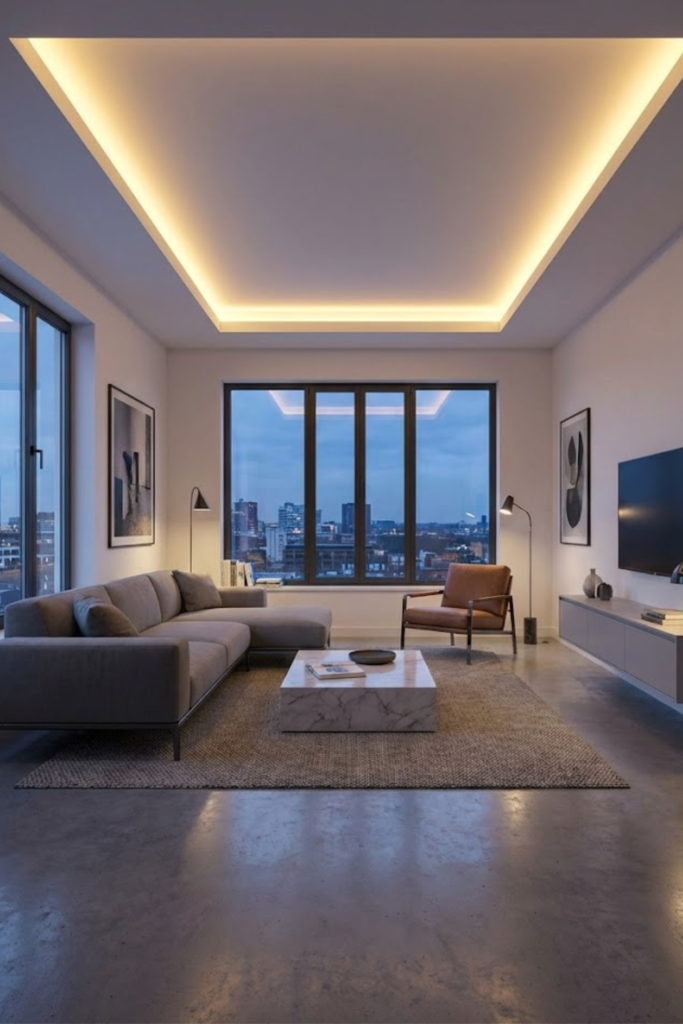
I have a bit of a confession. When I first heard the term “tray ceiling,” I honestly pictured a cafeteria tray stuck to the roof. Not exactly high-end design, right? But after seeing it in a friend’s newly built house, I totally changed my tune.
Basically, a tray ceiling (or inverted tray) is where the center of the ceiling is higher than the edges. It looks like an upside-down tray. If you have standard ceilings and want them to feel a little taller without actually raising the roof—which is impossible for most of us—this is the trick to use.
The “Hidden Glow” Trick
This is the coolest part and my favorite feature. You can hide LED strip lights inside that little lip where the ceiling drops down.
My brother-in-law did this in his media room. At night, he turns off the main lights, and there is this soft, cool glow coming from the ceiling. It looks super modern and hides the fact that you might just be watching Netflix in your pajamas. It makes the whole room feel fancy with zero effort. Plus, you don’t have to worry about dusting huge chandeliers.
Don’t Be Afraid of Color
Here is a mistake I see a lot: people paint the whole thing white. Boring!
If you paint the raised center part a slightly darker shade—like a light grey or even a soft blue—it tricks your brain. It makes that part look like it is further away, which makes the ceiling feel higher. It’s an optical illusion that actually works. Just don’t go pitch black unless you really know what you are doing, or it might feel like a black hole up there.
Is it a DIY Job?
Probably not for a beginner. Unlike the faux beams I mentioned earlier, this usually involves framing and drywall work. It gets messy and creates a lot of dust. If you aren’t handy with a mudding knife, you might want to hire a pro for this one. But for that extra feeling of height? It is totally worth the hassle.
4. Go Bold with Vibrant Wallpapered Ceilings
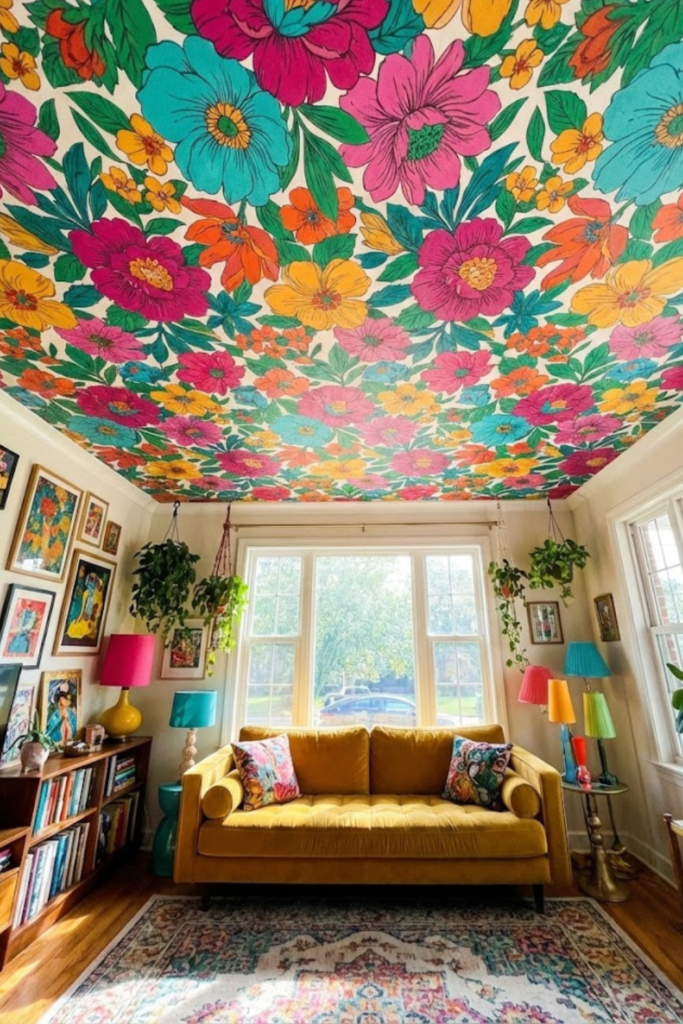
I used to think wallpaper was something you spent hours scraping off old walls, not putting up new. But putting it on the ceiling? That seemed a little wild to me at first. It sounds loud, I know. But if you have a living room that feels a little plain or boxy, this is the “jewelry” that fixes it.
It turns a boring white square into something that people actually stop and stare at.
The “Renter Friendly” Option
I have a friend who rents a small apartment downtown, and she was desperate to add some color but couldn’t paint. We found out about peel-and-stick wallpaper. It was honestly a lifesaver.
It is basically a giant sticker. If you mess up, you just pull it down and try again. Plus, when you move out, it peels right off without ruining the drywall. If you are nervous about committing to a permanent design, this is the best way to test the waters.
Watch Your Neck (Seriously)
Okay, I have to be real with you. Putting paper on a ceiling is not physically easy. Gravity is working against you the whole time. My neck was sore for two days after helping my sister do her small powder room.
If you are doing a big living room, get a second pair of hands. You need one person to hold the paper up and one person to smooth out the bubbles. Don’t try to be a hero and do it alone, or you will end up with a sticky mess tangled around your head.
Picking the Right Pattern
Since the living room is where you relax, be careful with the pattern. I once saw a ceiling with tiny, tight geometric shapes, and it actually made me feel a little dizzy looking up at it.
Large florals or soft, wide stripes usually work better because they are easier on the eyes. You want it to look interesting, not chaotic. Also, try to pick a color that matches something already in the room, like your rug or your sofa cushions. It ties everything together so the ceiling doesn’t look like it fell out of a different house.
5. Install Shiplap for that Cozy Coastal Vibe

I admit it, I watched way too many home renovation shows a few years ago. You know the ones where they put shiplap on everything? I honestly thought it was just a fad that would look dated in a year. But here I am, still recommending it.
Why? Because it brings this clean, beachy feeling to a room that plain paint just can’t do. Even if you live nowhere near the ocean (like me), it makes the living room feel airy and light. It adds texture without feeling heavy like those big wooden beams I talked about earlier.
The “Popcorn” Cover-Up
Here is the best secret about shiplap: it is the perfect disguise.
If you have those bumpy “popcorn” ceilings from the 80s that gather dust and are impossible to clean, shiplap is your best friend. Scraping that texture off is a messy nightmare—I tried it once in a bedroom and I’m still finding white dust in the closet. With shiplap, you can often just nail the planks right over the ugly drywall. It saves so much time and headache.
Direction Matters (A Lot)
Here is a tip I learned from a contractor friend at a barbecue. Which way you run the boards changes the whole room.
- Lengthwise: If you run the planks the long way down the room, it acts like an arrow. It draws your eye forward and makes the room feel longer.
- Widthwise: If you run them across the short side, it can make the room feel wider, but be careful. In a really small room, it might look like a ladder and make the space feel chopped up.
Don’t Forget the Gaps
If you decide to paint it white (which creates that classic coastal look), please do yourself a favor: paint the “tongue” or the edge of the board before you nail it up.
Wood shrinks a little bit in the winter when the air is dry. If you don’t paint the edges first, the boards might pull apart slightly, and you will see stripes of raw, brown wood peeking through the cracks. It drives me crazy when I see that at people’s houses! Taking that extra step keeps it looking clean all year round.
6. Incorporate Integrated Lighting with POP Gypsum Designs
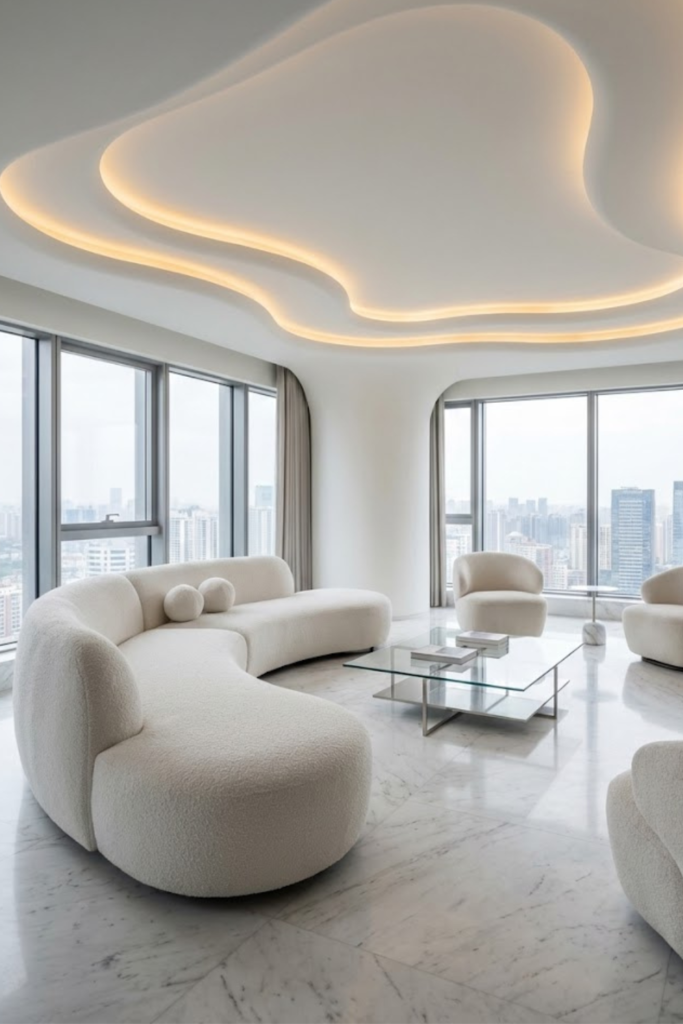
I used to have this one harsh lightbulb right in the center of my living room ceiling. It was awful. It cast weird shadows, and in the evening, it gave me a headache because it was so bright. I always wondered how fancy hotels got that soft, glowing light that seems to come from nowhere.
Then I learned about POP (Plaster of Paris) and gypsum false ceilings.
Basically, this involves building a second ceiling just a few inches below your main one. It sounds like a lot of work, but if you want that modern, clean look, this is the way to go.
The “Floating” Light Trick
The best part about these designs is what they call “cove lighting.”
My contractor explained it to me like this: you build a little shelf or ledge in the false ceiling and tuck LED strips inside it. The light bounces off the main ceiling and reflects down. It creates this soft, mood lighting that is perfect for watching movies. You don’t see the bulb, just the glow. It changed the whole vibe of my living room from “interrogation room” to “cozy lounge.”
Hiding the Mess
If you live in an older house like I do, you might have ugly wires or even ductwork sticking out. Or maybe your original ceiling is just cracked and uneven.
A gypsum false ceiling covers all that up. It is like putting a fresh sheet over a messy mattress. You get a perfectly smooth surface without having to chisel into concrete or patch a million cracks. Plus, it makes it super easy to add recessed “can” lights exactly where you need them, rather than where the original builder put the one junction box.
Separating Spaces Without Walls
I have an open floor plan where the living room bleeds right into the dining area. It felt a little disorganized.
Instead of building a wall, which would have made the house feel tiny, I used the ceiling to mark the spot. I dropped the ceiling height just a little bit over the living area. It creates a subtle border. Now, when you look up, you know exactly where the living room ends and the dining room begins, but you still keep that big, open feeling. It’s a smart trick if you want to define your space without blocking the view.
7. Paint it Dark for a Moody, Sophisticated Look

This one is for the brave souls out there. For years, my mom told me that ceilings had to be white. It was just the rule. If you painted it any other color, the room would feel small and you would regret it. Well, sorry mom, but I broke the rule, and I am so glad I did.
I decided to paint the ceiling in my den a deep charcoal gray. I was terrified while I was rolling it on. It looked so dark! But once the furniture was back in, the room didn’t feel small—it felt like a warm hug. It had this moody, sophisticated vibe that made me want to curl up with a book and never leave.
Why It Works (The “Cozy” Factor)
Here is the trick: dark colors visually lower the ceiling.
Now, if you have really low ceilings already, maybe skip this. But if you have a room that feels a little too big or cold, a dark ceiling brings everything down and pulls the room together. It makes the space feel intimate. It stops your eye from wandering up into empty space and keeps the focus on the people and furniture in the room.
Matte vs. Glossy: A Big Lesson
I made a huge mistake on my first try. I used a semi-gloss paint because I thought it would be easier to clean.
Bad idea.
Shiny paint acts like a magnifying glass for imperfections. Every little bump in the drywall stood out like a sore thumb. Plus, the reflection from the lamps made weird glares. If you are going dark, stick to flat or matte paint. It absorbs the light and hides all those little flaws, making the ceiling look velvety and smooth.
Balance is Key
You don’t want your living room to look like a dungeon. If you paint the ceiling black or navy, keep the walls lighter.
In my den, I kept the walls a creamy white and used light-colored curtains. The contrast is what makes it look designed, rather than just dark. It gives the room some breathing room so the dark ceiling feels like a feature, not a mistake. It is a bold move, but it pays off big time if you just balance it out right.
Conclusion
So, there you have it. Changing your ceiling sounds like a huge, scary job—I know, I’ve stared at my own ceiling wondering what on earth I was thinking—but it really pays off. It’s funny how we spend so much time picking out the perfect rug or the right color for the walls, but we totally forget about the space right above us.
Whether you decide to glue up some faux beams (my personal favorite for a quick fix), try that moody dark paint, or go all out with a coffered look, just remember that it’s your home. It should make you happy when you walk in. Don’t worry about being perfect. My first DIY ceiling project had a few crooked lines, but you know what? No one ever noticed but me.
Take a deep breath, grab your ladder, and give your living room the lift it deserves. You’ve got this!
Enjoyed these ideas? Pin this article to your “Home Decor” board on Pinterest to save it for later!