I remember staring at my bathroom walls back in 2019—everything was just… beige. Not the cool, textured beige we see in magazines today, but that flat, sad “builder-grade” beige that makes you want to nap, and not in a good way. I honestly hated it! I tried adding a bright blue shower curtain to “fix” it, but it just looked like a clown nose on a statue. You know what I mean? It was a total clash.
That’s when I learned the hard way that neutral doesn’t have to mean boring. In fact, in 2026, neutral decor is basically the heavy lifter of interior design. It’s all about creating a “soft sanctuary” that feels like a hug when you walk in. We aren’t just talking about painting things white anymore. We are talking about layers, textures, and those warm, earthy vibes that make a space feel expensive without shouting.
If you are stuck thinking neutral means “hospital sterile,” you are in for a treat. I’ve rounded up some killer ideas that mix warmth, stone, and wood to give you that high-end spa look right at home. Let’s dive in.
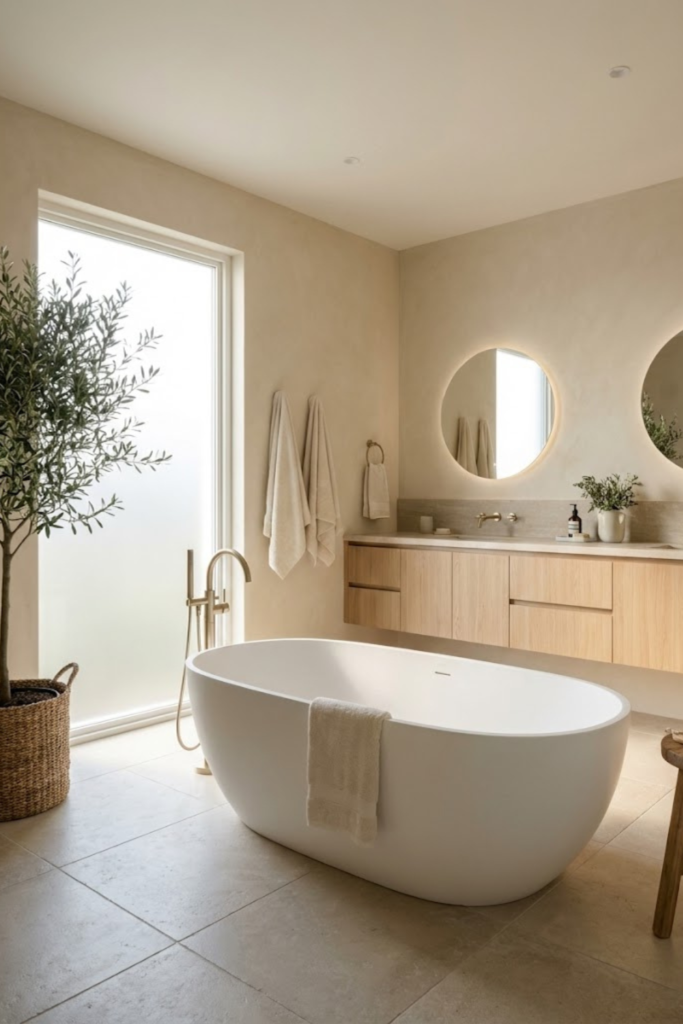
1. Focus on Texture, Not Just Color
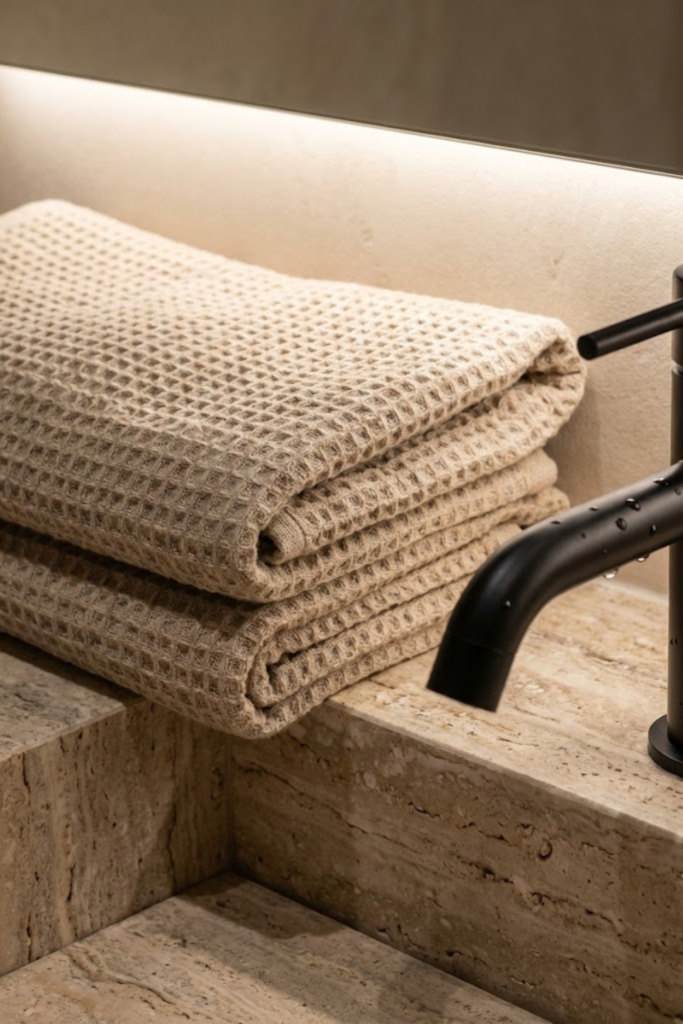
I used to think that “neutral” meant everything had to be smooth and perfectly matched. I remember painting my first guest bath a soft oatmeal color—walls, trim, everything. I stepped back, expecting it to look like a magazine cover. Instead, it just looked… flat. It was boring. I couldn’t figure out why it didn’t feel cozy or expensive. It just felt like a box.
That’s when I learned the biggest secret to neutral decor: if you aren’t using bright colors, you absolutely have to use texture. It’s not about what color things are; it’s about how they feel when you touch them and how they look when the light hits them. Texture creates shadows, and shadows give a room life.
Why Smooth Surfaces Can Fail
When everything in your bathroom is sleek—shiny tile, smooth porcelain sink, glass mirror, flat painted walls—your eye has nowhere to rest. It just slides right off everything. In a neutral space, this makes the room feel cold and sterile, kind of like a hospital. We want a spa, not a clinic! By mixing up the surfaces, you force the eye to stop and look. It creates that cozy, “lived-in” feeling that we all want.
The Magic of Waffle Weave and Knits
The easiest place to start is with your fabrics. If you have plain cotton towels, swap them out. I recently bought these waffle-weave towels that have a deep honeycomb texture. Just hanging them on the hook changed the whole vibe of the room. They look fluffy and interesting even when they are just sitting there.
Don’t stop at towels. Look at your bath mat. Instead of a flat, rubber-backed mat, try something with a nubby texture or a thick, woven cotton rug. These soft elements break up all the hard, cold surfaces of the tile and tub. It is such a simple switch, but it makes a huge difference in how warm the room feels.
Hard Textures Add Character
You can do this with the hard stuff, too. I swapped my shiny ceramic soap dispenser for a rough, stone one that looks like it came from a riverbed. It sits on the smooth vanity, and that contrast—rough stone against smooth counter—is what makes it look designed.
If you are ready for a bigger project, think about your walls. Limewash paint is great because it has a chalky, cloudy texture that isn’t perfectly flat. It gives the walls some movement so they don’t look like a plain sheet of drywall. It’s all about layering these different feelings—rough, soft, shiny, matte—to make the space feel full without adding a single drop of bright color.
2. Bring in Warm Wood Accents
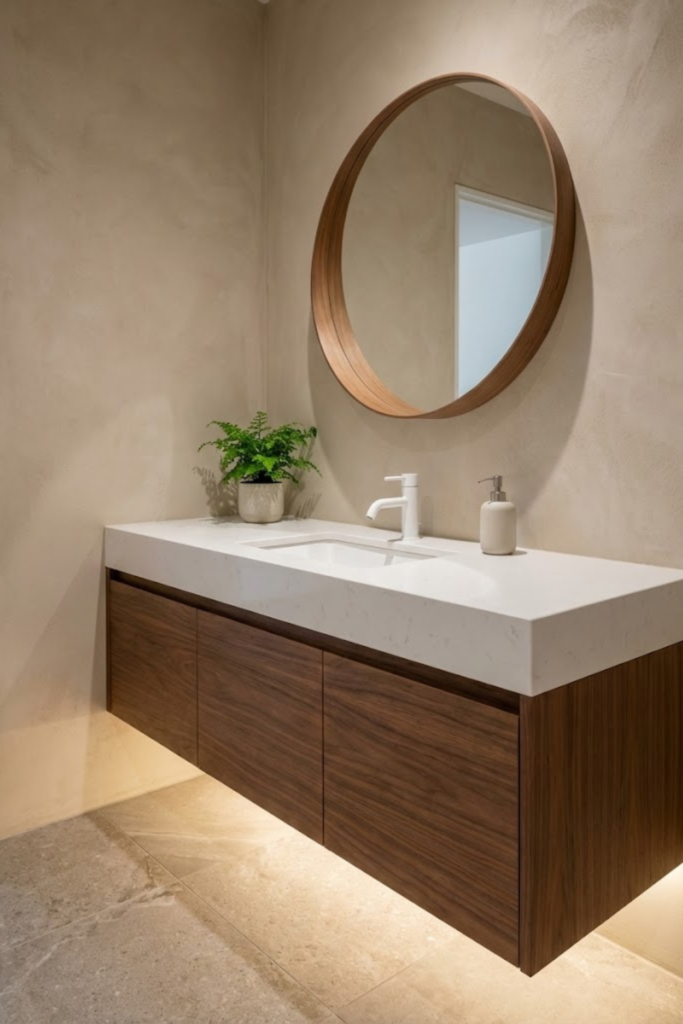
I have to admit, there was a time when I thought wood in a bathroom was a terrible idea. I mean, moisture and wood don’t exactly get along, right? So, for the longest time, I avoided it completely. My bathroom was all white tile, white sink, and shiny silver faucets. And you know what? It felt like walking into a refrigerator. It was clean, sure, but it wasn’t welcoming. It completely lacked soul.
That changed when I visited a friend who had these beautiful, chunky wood shelves installed right over the toilet. Just that little bit of natural brown made the whole white room feel grounded and cozy. It changed my mind instantly. Now, I tell everyone that adding warm wood is the quickest way to fix a bathroom that feels too sterile.
The Shift Away from Grey
For a long time, everyone was doing that grey-washed wood look. You probably saw it in every flipped house for five years straight. But honestly, it can look a bit fake and surprisingly cold. Lately, I’ve been seeing a big return to natural, warm tones. Think honey-colored oak or rich, dark walnut. These colors bring a bit of nature inside, which is exactly what a neutral bathroom needs to feel alive.
If you have a stark white vanity, you don’t have to rip it out. That’s too much work and money. Instead, try bringing in wood through accessories. I found this simple teak stool at a discount store and put it in the corner with a folded towel on it. It instantly warmed up the space without me having to pick up a screwdriver.
Start Small with Shelves and Trays
If you are nervous about committing to wood, start small. A wooden tray on the back of the toilet tank is perfect for holding extra toilet paper or a nice candle. It covers up the cold porcelain and adds that natural texture we talked about earlier.
Floating shelves are another winner. I put up two raw wood shelves above my towel bar last year. It gave me a place to put plants and pretty bottles, but mostly, it just broke up all that empty wall space. It makes the room feel finished and thoughtful.
What About the Water?
I know, you are probably worrying about rot. I was too. The trick is to look for woods like teak, bamboo, or acacia that naturally handle water well. They are dense and oily, so they don’t soak up water like pine does. If you do use regular wood, just make sure it is sealed properly. I usually grab a little can of matte sealer from the hardware store and give any new wood piece a quick coat before I bring it in. It takes ten minutes and saves you a lot of headache later.
It’s really not hard to mix these elements in. You just need to be brave enough to try it. The warmth it adds is totally worth the extra step of sealing a shelf. When you turn on the lights in the evening, the warm wood glows differently than cold tile. It absorbs the light instead of bouncing it around like a disco ball, making your evening routine feel way more relaxing.
3. Use “Jewelry” Lighting (Sconces)
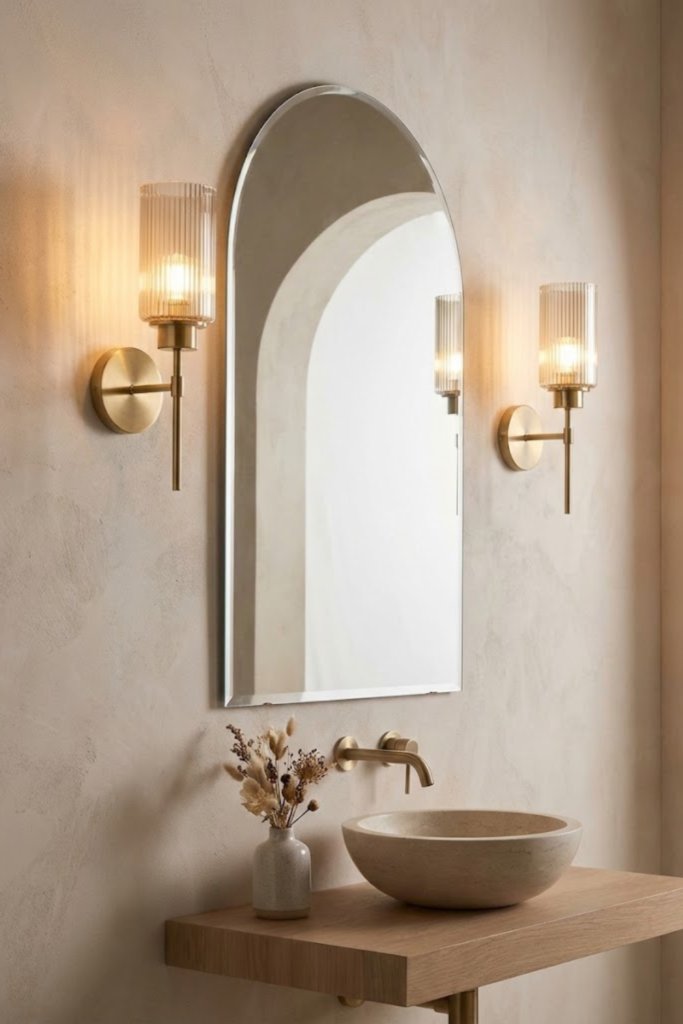
Lighting is one of those things we often ignore until we realize how much we hate it. I lived for years with a standard, builder-grade light bar right above my mirror. It had those big, round bulbs that looked like they belonged in a Hollywood dressing room from the 80s. The problem was, every time I looked in the mirror, I looked tired. The light was coming from above and casting these long, dark shadows under my eyes. It wasn’t flattering, and it definitely didn’t make the bathroom feel relaxing.
I started thinking of lighting as the “jewelry” of the room. Just like a nice pair of earrings can pull an outfit together, the right light fixtures can finish a room. In a neutral bathroom where you don’t have crazy colors on the walls, your lights get to be the star of the show.
Why Placement Changes Everything
The biggest game-changer for me was ditching that overhead light bar. Instead, I switched to sconces—those lights that mount on the wall. The trick is to put them at eye level, on either side of the mirror. This is a huge deal for anyone who puts on makeup or shaves in the bathroom.
When the light hits your face from the sides, it washes out the shadows instead of creating them. It makes you look awake and refreshed, which is exactly how you want to feel in the morning. Even if you can’t move the electrical box, simply changing the fixture to something that hangs down a bit lower can help soften the look.
Picking the Right Finish
Since your walls are neutral—maybe white, cream, or beige—you need the metal of the light fixture to pop. This is where you can have some fun. I used to play it safe with chrome because it matched the faucet, but chrome can feel a little cold.
Lately, I’ve fallen in love with brushed brass or a warm bronze. These gold-toned metals look incredible against a pale wall. They add a little bit of sparkle and warmth that you just don’t get with silver. It feels luxurious, almost like a hotel, without costing a fortune. If brass feels too flashy for you, matte black is another great option. It acts like an eyeliner for the room, adding a crisp, sharp accent that grounds the space.
Don’t Ignore the Light Bulb
You can buy the most beautiful light fixture in the world, but if you put the wrong bulb in it, the room will look terrible. I learned this the hard way when I accidentally bought “Daylight” bulbs. My bathroom glowed blue like a grocery store aisle. It was awful.
For a neutral bathroom, you want a bulb that says “Warm White” or has a number around 2700K on the package. This gives off a soft, yellow-ish glow that makes beige tiles look creamy and rich. It mimics the feeling of candlelight or sunset. It makes the whole room feel cozy and inviting, rather than clinical. It is a tiny detail, but it makes or breaks the vibe.
4. Embrace Organic, Curved Shapes
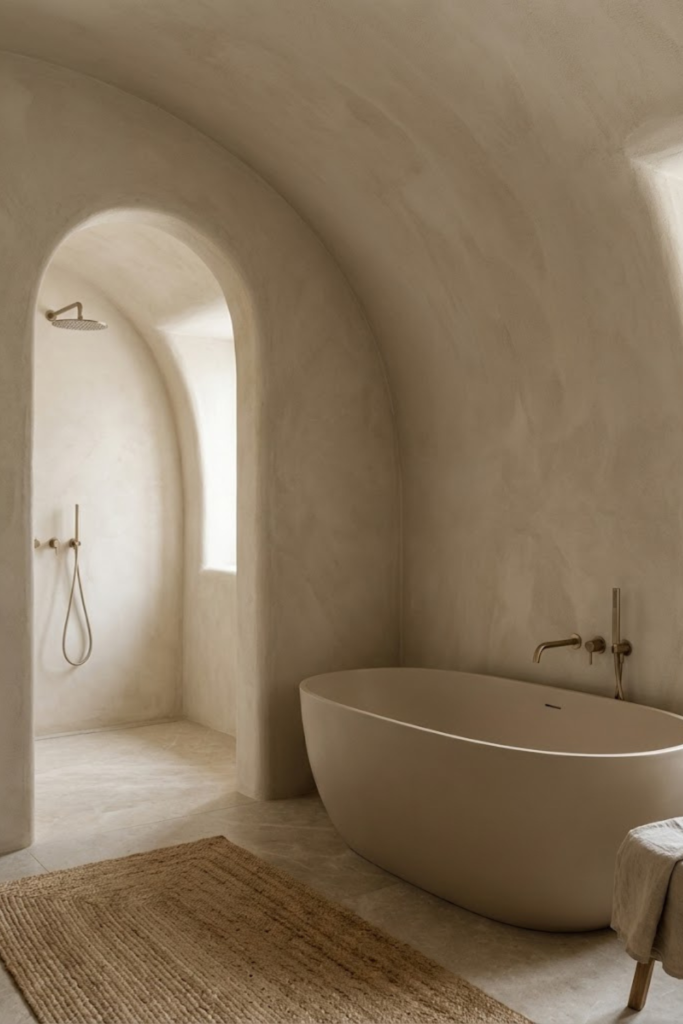
I used to be obsessed with clean lines. When I redid my master bath a few years ago, I went overboard. Square tiles, a rectangular floating vanity, a sharp square mirror, and even square faucets. I stepped back when it was done and realized I had basically built a Lego set. It felt incredibly rigid. There was no flow. It was just a box inside of a box.
That is the danger with neutral decor. When you strip away color, the shapes in the room become really obvious. If everything has a sharp 90-degree angle, the room feels strict. It doesn’t exactly scream “relax and unwind,” does it? It feels more like a place to file your taxes than take a bath.
The “Soft Geometry” Fix
In 2026, we are seeing a massive shift toward what designers call “Soft Geometry.” It sounds fancy, but it just means using curves to break up all those straight lines. I decided to try this out by swapping that harsh square mirror for a large, arched one.
I’m telling you, the difference was instant. The curve of the arch softened the whole wall. It tricked the eye into thinking the ceiling was higher and made the vanity area feel less aggressive. If you are stuck with a boxy bathroom, an arched or round mirror is the single best thing you can buy. It is a low-effort swap that pays off big time.
You Don’t Need a Sledgehammer
You might be thinking, “Well, I can’t exactly install an arched doorway or buy a new oval bathtub right now.” And you don’t have to. The goal is just to interrupt the straight lines.
Look at your accessories. I traded my rectangular bath mat for a round one, and it made the floor look wider. I swapped my square soap dish for a little organic, pebble-shaped stone bowl. These are tiny changes, but they add up. It’s about creating a visual balance.
Why It Feels Better
There is actually some psychology behind this. Humans are naturally drawn to curves; they remind us of nature—stones, clouds, waves. Sharp corners are rare in the wild. By bringing those organic shapes into your bathroom, you are subconsciously telling your brain it is safe to relax.
If you are planning a bigger renovation, definitely look into a freestanding oval tub or a round vessel sink. But if you are just refreshing a rental or working on a budget, focus on the decor. A round stool in the corner, a curved vase with some eucalyptus, or even a shower curtain with a scalloped edge can do the trick. It stops the room from feeling like a sterile lab and turns it into a soft sanctuary.
5. Layer Shades of Stone and Clay
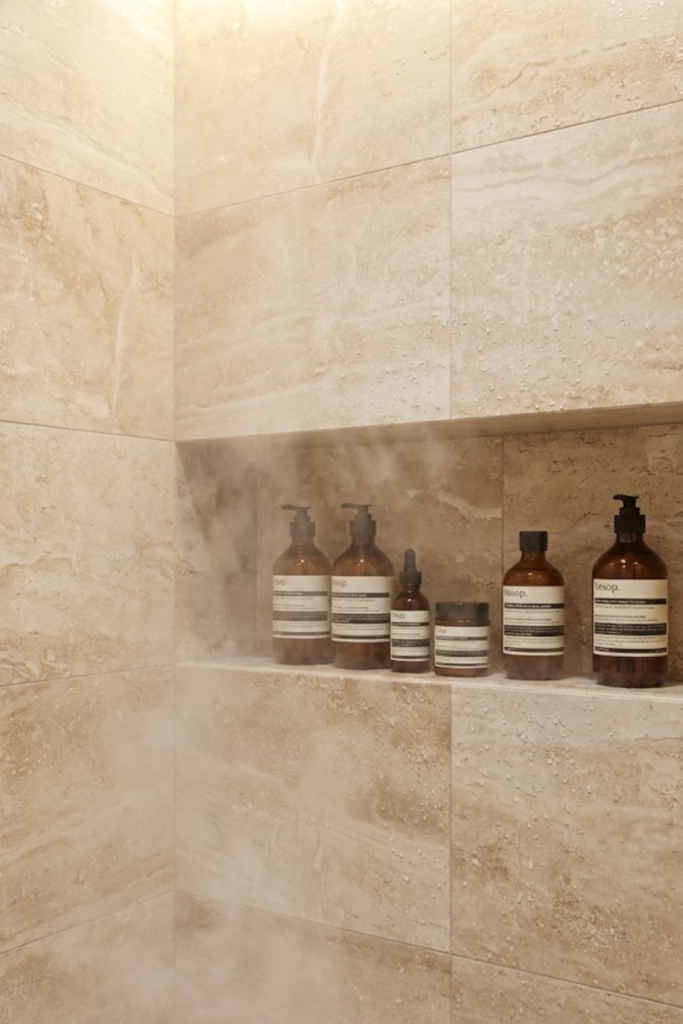
I have a confession: I used to be obsessed with matching everything perfectly. When I renovated my first bathroom, I carried a piece of floor tile around in my pocket for weeks. I was trying to find a paint color that was the exact same shade of beige. I thought that if everything matched, it would look seamless and professional.
I was wrong. When I finished painting, I stood back and realized I had created a “beige blob.” The room had zero definition. The walls blended into the floor, which blended into the vanity. It was dizzying, and honestly, it looked cheap. It lacked that depth you see in those high-end hotel bathrooms.
The “Tone-on-Tone” Trick
That is when I learned about layering. The goal isn’t to match the colors; it is to find cousins of the color. If your tile is a warm oat color, don’t paint the walls oat. Paint them a lighter cream or a darker clay.
In 2026, we are seeing a lot of what designers call “monochromatic” styling, but I just call it “layering.” By mixing different shades of the same color family—like sand, mushroom, and taupe—you create a space that feels rich and curated. It gives your eye something to explore. It makes the room feel established, like it has been there for a long time, rather than something you bought as a matching set from a catalog.
Why Travertine is the Star
This is why stones like travertine and limestone are so popular right now. I recently swapped out a plain white countertop for a slab of travertine, and it changed everything. Travertine isn’t just one color. It has swirls of cream, tan, and even little bits of grey.
Because the stone has so much natural variation, it ties everything else in the room together. It bridges the gap between your white tub and your beige walls. It does the heavy lifting for you. Plus, it has those little natural holes and pits that add texture (remember rule #1?), which stops the room from feeling too slick.
Get the Look with Paint
Now, I know real stone is expensive. If you can’t afford a new vanity or new tile, you can fake this look with paint. I am a huge fan of limewash paint or “Roman clay” finishes.
I used a lime paint in my powder room last month. Unlike regular latex paint that covers everything in a plastic-like shell, limewash dries with a cloudy, matte finish. It looks like old-world plaster. It creates those subtle highs and lows in the color that you get with real stone. It instantly makes a drywall box feel like an earthy, clay sanctuary. It’s a bit of a workout to apply—you have to brush it on in X-shapes—but the result feels incredibly high-end and cozy.
6. Add Life with Greenery
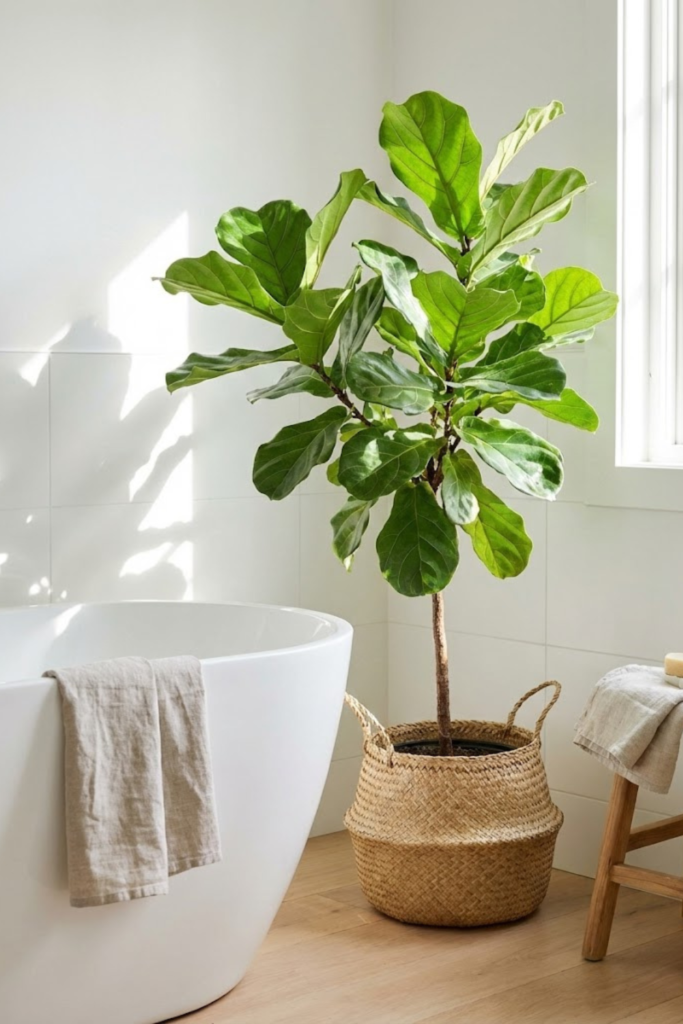
I used to think plants belonged in the living room or maybe the kitchen window. My bathroom was strictly for towels, soap, and getting ready in the morning. But after I painted everything that soft “oatmeal” color I told you about, something was missing. The room looked clean, but it felt a little bit dead. It didn’t have any energy. It was just… beige walls and white tile.
I grabbed a small potted fern from my porch and just set it on the back of the toilet to see what would happen. Boom. Instant life. That pop of green against the neutral walls didn’t clash; it actually made the beige look cleaner and crisper.
Nature’s Best Neutral
Green is basically nature’s neutral. Think about it—outside, green goes with dirt, rocks, sky, everything. It works the same way in your home. It breaks up the monotony of tile and stone without making the room feel busy or cluttered. It brings the outdoors in, which is the whole point of that “spa vibe” we are chasing. It stops the room from feeling like a sterile box and makes it feel like a living, breathing space.
You Don’t Need a Green Thumb
Now, I know what you are thinking. “I will kill it in a week.” I get it. I’ve killed my fair share of succulents. But the bathroom is actually the easiest place to keep plants alive because of the shower. The humidity does half the work for you.
My absolute favorite is the Pothos (sometimes called Devil’s Ivy). It is nearly impossible to kill. It loves the steam from your shower, and it vines out beautifully. I have one on top of a cabinet, and the vines trail down the side—it looks like something from a jungle hotel. Snake plants are another winner. They grow straight up, stiff and tall, so they are great for tight corners or narrow shelves where you don’t have much room. They don’t need much light or water, so you can basically ignore them, and they still look great.
What if You Have No Windows?
If you have a bathroom with zero windows (like my downstairs powder room), don’t give up. You have two options. First, you can try a high-quality fake plant, but be careful—cheap ones look really plastic and can ruin the look.
Second, and this is my favorite trick: dried eucalyptus. You can buy a bundle of it at the grocery store or flower shop. Tie it to your shower head or put it in a vase on the vanity. It smells amazing when the hot steam hits it, and since it is already dried, it doesn’t need sunlight. It adds that organic, leafy texture we want, without the worry of keeping something alive in the dark. It is a win-win.
7. Mix Your Metals
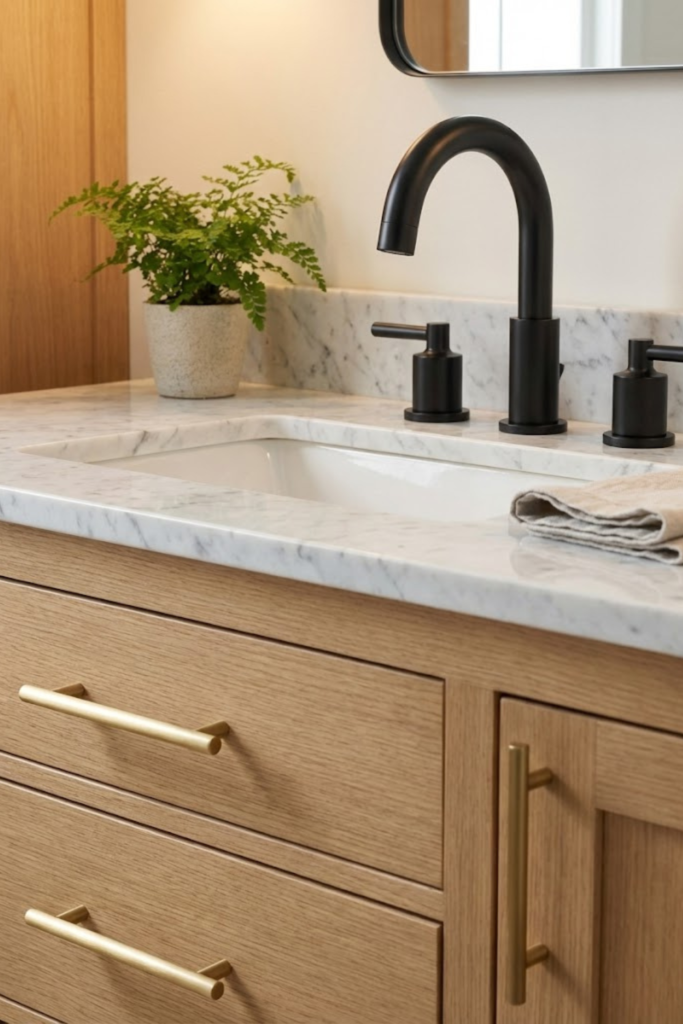
I grew up believing there was one golden rule in home design: “Match your metals.” If the faucet was chrome, the cabinet handles had to be chrome, the towel bar had to be chrome, and the light fixture definitely had to be chrome. I followed this rule religiously. I thought that if I mixed silver and gold, it would look like a mistake.
But when I finished my first renovation, the room felt… flat. It looked like I had bought a “bathroom in a box” kit from the hardware store. It was perfectly coordinated, but it had zero personality. It didn’t feel custom; it felt generic. That is when I learned that breaking this rule is actually the secret to making a room look professionally designed.
The “Collected” Look
Mixing metals works because it adds layers to the room. When everything matches perfectly, your eye glazes over it. When you mix finishes—like pairing a matte black faucet with brass cabinet pulls—you create contrast. It tells a story. It makes the room look “collected” over time, rather than something you just ordered from a catalog on a Tuesday.
In a neutral bathroom, this is even more important. Since you don’t have bright blue or green walls to grab attention, the metal finishes become the stars. They add the sparkle and the definition that the room needs.
How to Do It Without It Looking Messy
I know it sounds risky. You don’t want your bathroom to look like a scrap yard. The trick is to have a plan. I like to pick one dominant metal and one accent metal. Think of it like a main character and a sidekick.
For example, let’s say your “main character” is matte black. You use that for the big stuff: the faucet, the showerhead, and maybe the towel bar. Then, you bring in the “sidekick”—let’s say, brushed brass or gold—for the fun stuff. Use the gold for the cabinet knobs, the light fixtures (the jewelry!), or the mirror frame.
My Favorite Combinations
If you are nervous, start with black and brass. It is a classic combo that looks amazing in 2026. The black feels modern and grounds the space, while the brass adds warmth and elegance. It works perfectly with those oatmeal or creamy walls we talked about.
Another great option is polished nickel and black. Nickel has a warmer, honey-like tone compared to cold chrome, so it plays really well with black accents. Just try to avoid mixing two metals that are too similar, like brushed nickel and chrome. They look like you tried to match them and failed. Go for high contrast, and it will look intentional every time.
Conclusion: Creating Your Quiet Escape
When I finally finished my bathroom renovation, I remember just standing in the doorway with a cup of coffee, staring at it. For years, I had chased trends—bright turquoise walls in college, a weird geometric wallpaper phase in my 30s. They were fun for a minute, but they never made me feel calm. They always felt like they were shouting at me.
Looking at this new, neutral space, I realized something important. A neutral bathroom isn’t about playing it safe or being afraid of color. It is about creating a quiet backdrop for your life. We are so overstimulated these days. Our phones are buzzing, the news is loud, and work is crazy. When you walk into your bathroom—whether it is to shower before work or wash your face at night—you want a place that asks nothing of you. You want a space that just lets you breathe.
That is why these layers matter. The rough texture of a stone soap dish, the warm glow of a brass light fixture, the soft curve of a round mirror—they all work together to create a feeling. It’s that “exhale” moment. You aren’t distracted by a jarring paint color or a busy pattern. You just see warmth, light, and natural materials.
If you are feeling overwhelmed by all these ideas, please don’t think you have to do them all this weekend. That is the quickest way to burn out. Start with one thing. Go buy a really nice, textured bath mat. Or swap out that cold white light bulb for a warm one. Live with it for a week. See how it changes the mood. Then, maybe add a wooden shelf or a plant. The best spaces, the ones that really feel like home, are the ones that come together slowly over time.
I hope these ideas gave you the confidence to embrace the “boring” beige and turn it into something special. It really is my favorite way to decorate now.
If you found these tips helpful and are planning your own sanctuary, I would love for you to save this post to your “Bathroom Inspiration” or “Home Decor 2026” board on Pinterest. It helps other people find these ideas, and it keeps them saved for when you are ready to start your project!