Have you ever stepped on a Lego brick at 6 AM while trying to admire your “aesthetic” living room? Yeah, me too! It’s the classic battle: you want a space that looks like it belongs in a magazine, but you actually live with tiny humans (or messy teenagers) who believe sofa cushions are for building forts, not sitting. But here’s the good news: in 2026, we are finally ditching the “look but don’t touch” museum vibe.
The trend is shifting toward “purpose-driven homes” that prioritize genuine utility and wellness without sacrificing style. We are seeing a move away from cold minimalism toward “quiet maximalism”—spaces that feel collected, cozy, and forgiving. Whether you are dealing with sticky fingers or just want a space that hugs you back after a long day, these design concepts bridge the gap. In this article, I’ll walk you through seven family living room designs that are as durable as they are beautiful.
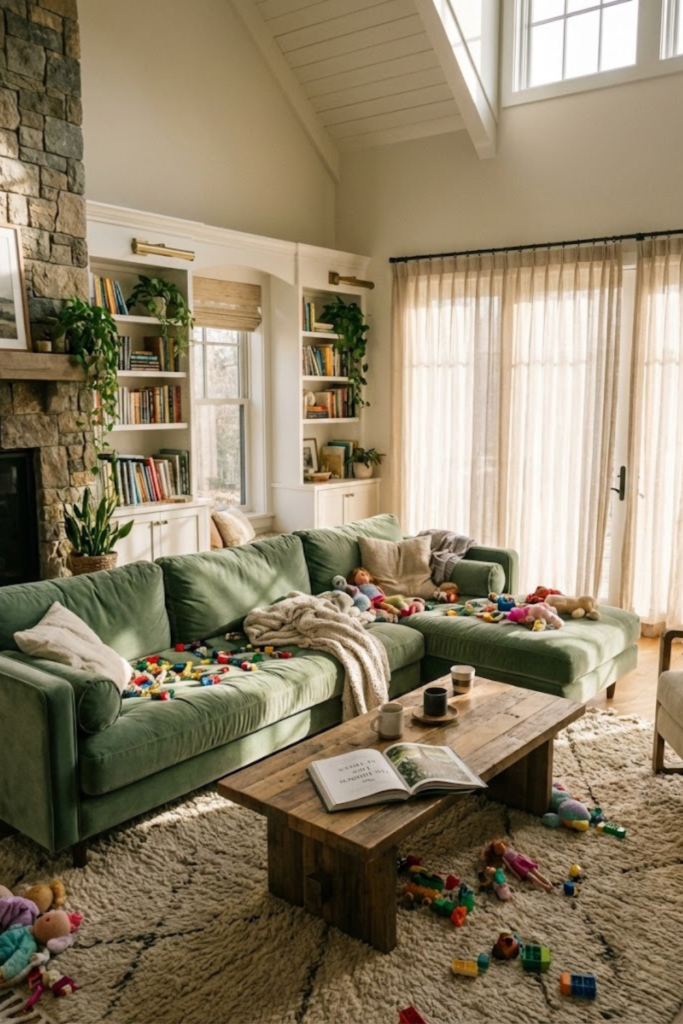
1. The “Analogue” Zone: Reclaiming Connection
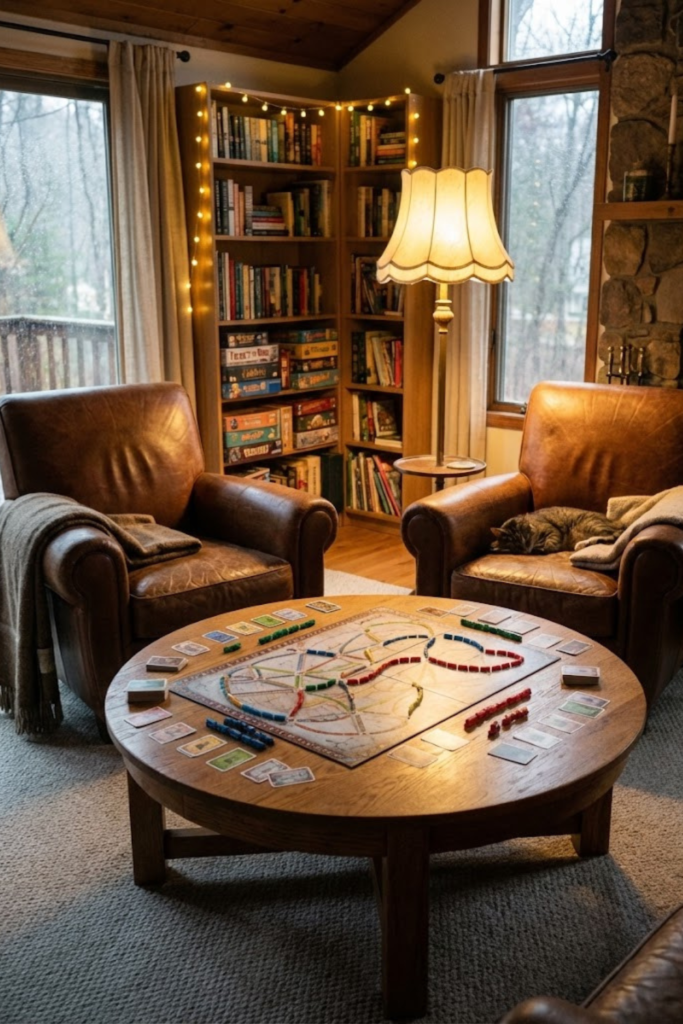
You know that sinking feeling when you look around your living room and every single person is staring at a phone? It drives me nuts. As a teacher, I see kids glued to screens all day at school, and honestly, I am guilty of it too. In 2026, we are all just a little tired of the constant scrolling. That is why this design idea is my absolute favorite. It is about carving out a specific spot in your living room where the Wi-Fi signal doesn’t matter. It isn’t about being anti-tech, but about making a space where looking at each other is the main event. We call it the “Analogue Zone” in my house, though my teenagers sometimes call it “The Boring Corner” until they actually sit down and start laughing at a board game.
Why You Need a Screen-Free Spot
The goal here is simple: actual human connection. If your furniture points at a TV, you watch TV. If your furniture points at other people, you might actually talk. I rearranged my living room last year to test this out. I pulled the chairs away from the wall and faced them toward the sofa. Suddenly, we weren’t just sitting near each other; we were with each other. It is a small change, but it shifts the whole vibe of the room. You stop doomscrolling because there is literally nothing to watch but your family’s faces. It forces you to slow down.
The Magic of “Analogue Bags”
Okay, so this is a trend I jumped on recently, and it is a game changer. Have you heard of “analogue bags”? It sounds fancy, but it is really just a nice basket or tote bag filled with stuff to do that isn’t digital. I keep one right next to the big armchair. Inside, there is a couple of crossword puzzle books, some knitting I have been failing at for three years, and a deck of cards.
When the urge to pick up my phone hits, I reach for the bag instead. It works wonders for the kids too. If you leave a comic book or a Rubik’s cube sitting out on the coffee table, they will pick it up eventually just out of boredom. It keeps their hands busy without needing a charger.
The Coffee Table is the Anchor
For this to work, you gotta ditch the stadium seating layout. Don’t push everything against the walls! You need a central anchor, and that is usually a big, sturdy coffee table. In this zone, the table isn’t just a place to put your feet; it’s a desk for puzzles, a battleground for Monopoly, or a place to dump that bag of legos.
Make sure the lighting helps, too. Use a warm lamp that makes the space feel cozy, like a hug. If it feels cold or dark, nobody is gonna want to sit there. Make it the most comfortable spot in the house, and the “no phone” rule won’t even feel like a rule.
2. Biophilic Maximalism: Texture-Maxxing for Comfort
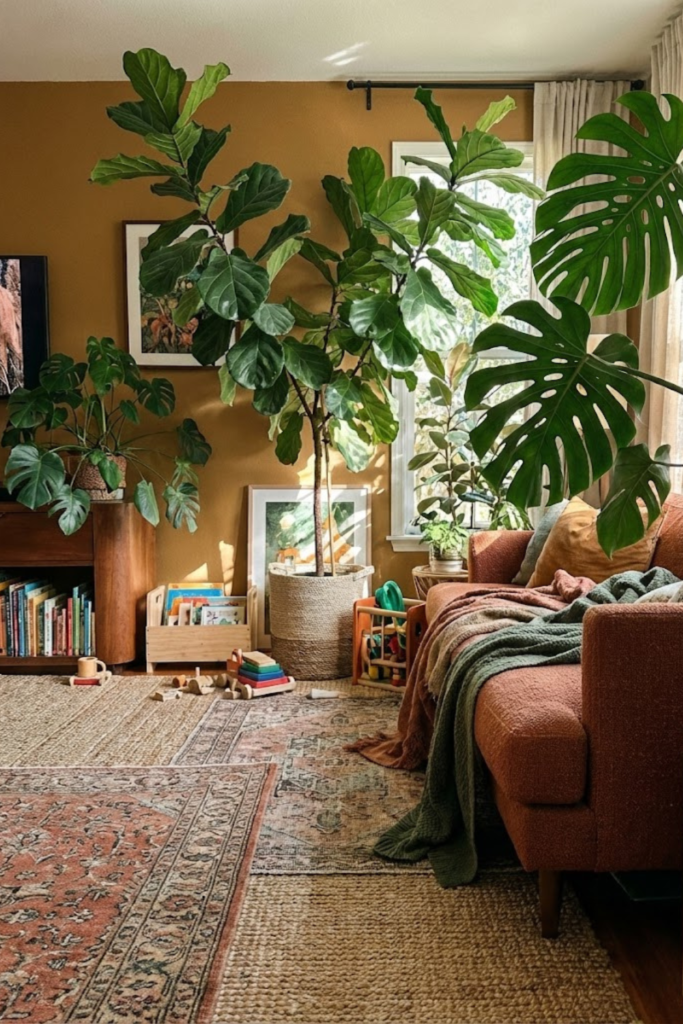
I have to admit something embarrassing. A few years ago, I bought this sleek, flat-weave beige rug. I thought it made my living room look like a spa. Two days later? Juice box explosion. That stain stared at me for months. It was a rookie mistake. In 2026, we are smarter than that. We are embracing “Biophilic Maximalism,” which is just a fancy way of saying “lots of plants and lots of texture.” As a teacher, I need my home to feel like a retreat, not a sterile hospital waiting room. And let me tell you, texture is the best friend a parent can have.
Why “Texture-Maxxing” Saves Your Sanity
Here is the secret I learned the hard way: flat fabrics show every single speck of dirt. Textured fabrics hide a multitude of sins. When we talk about texture-maxxing, we mean layering materials that have some grit and depth to them. Think nubby wool blends, boucle (yes, it’s still in!), or heavy velvets.
I swapped that sad beige rug for a high-pile, patterned wool one, and it was life-changing. Now, if a few crumbs fall, they kind of just… disappear into the abyss until vacuum day. It buys you time. Plus, it feels amazing on your feet. My kids actually prefer sitting on the floor now because it’s so soft. It makes the whole family living room feel like a giant, durable nest.
Bring the Outside In (Without the Bugs)
The “Biophilic” part is about connecting with nature. But listen, I kill everything. I have a “black thumb.” So, I started with Snake Plants and ZZ plants because they thrive on neglect. Seriously, you can forget them for three weeks, and they still look happy.
Adding real plants changes the air in the room. It feels fresher, less stuffy. And don’t worry about it looking like a jungle gym; the goal is “organized chaos.” I put the big pots in heavy ceramic planters so the dog can’t knock them over. It stops the room from feeling too precious. If a leaf tears, it grows back. It’s forgiving, just like a family home should be.
Layering is Your Best Defense
Don’t be afraid to layer rugs. I know, it sounds weird, but hear me out. Put a large, durable jute rug down as a base (it’s cheap and tough), and then layer a softer, smaller vintage or patterned rug on top in the center. It looks designed and intentional, but it also creates a designated “soft zone” for play.
If one layer gets ruined, you don’t have to replace the whole floor covering. It’s practical, it looks rich, and it creates that cozy, “lived-in” vibe that we are all craving right now. It stops the echo, too—which, if you have loud kids like mine, is a blessing all on its own.
3. The “Conversation Pit” Revival: Curved & Facing Layouts
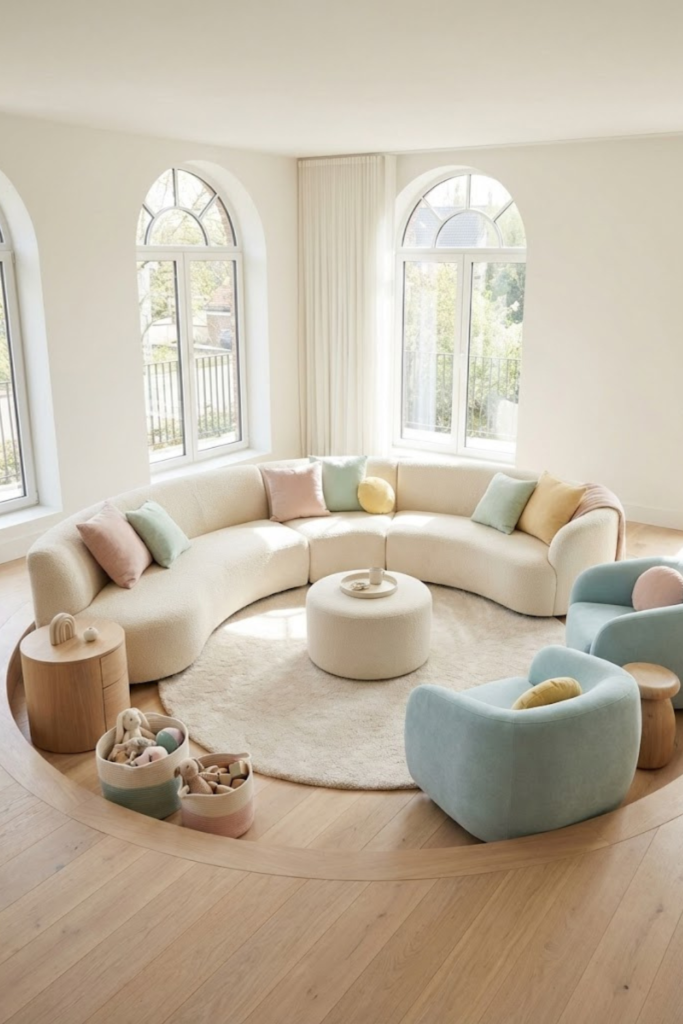
If you grew up in the 70s or have seen old photos of your parents’ house, you probably remember the “conversation pit.” It was that sunken square in the middle of the floor filled with shag carpet where everyone hung out. While I am not suggesting you grab a shovel and start digging a hole in your living room floor (who has the budget for that?), the idea behind it is making a huge comeback in 2026. We are craving that closeness again. In my house, we call it the “soft circle.” It’s all about creating a space that feels like a hug, without the construction dust.
Why Curves Are a Parent’s Best Friend
Let’s talk about sharp corners. I cannot tell you how many times I have held my breath watching my toddler run past the coffee table. The sharp edges on modern furniture are basically just bruises waiting to happen. This revival is amazing for families because it embraces curves.
We are seeing “kidney bean” shaped sofas and round ottomans everywhere this year. It is not just a style choice; it is a safety feature. When I swapped my rectangular coffee table for a round wooden one, the whole room felt softer. There are no hard angles to bump into. It creates a flow that is easier to walk through, especially when the floor is covered in toys. A curved sofa naturally turns people toward each other, making the room feel cozy and contained, rather than stiff and formal.
Float Your Furniture
The biggest mistake people make is pushing all their furniture against the walls. I used to do it too because I thought it made the room look bigger. But actually, it just makes the middle of the room look like a dance floor that nobody uses. To get that “conversation pit” vibe, you have to be brave and pull the furniture into the center.
Try “floating” your sofa in the middle of the room. Place two armchairs opposite it to close the circle. It creates an intimate zone within the larger room. When you sit down, you are close enough to talk without shouting across the room. It feels private and protected. My teenagers actually hang out here more often now because it feels like a little fortress.
Creating the “Sunken” Feel with Rugs
Since we aren’t actually sinking the floor, we have to cheat. You can create the illusion of a pit by using a really plush, thick rug that anchors the furniture. The rug defines the “pit.” Keep the colors of the sofa and chairs similar to create a unified look, almost like a built-in bench.
When you step onto the rug, it should feel like you are entering a separate zone. It signals to your brain that this is the place to sit and relax. It turns the living room from a hallway you walk through into a destination you want to stay in. Plus, if you use durable fabrics like we talked about before, you won’t panic when someone puts their feet up. It’s all about being comfortable together.
4. Multifunctional Zoning: The “Broken Plan” Approach
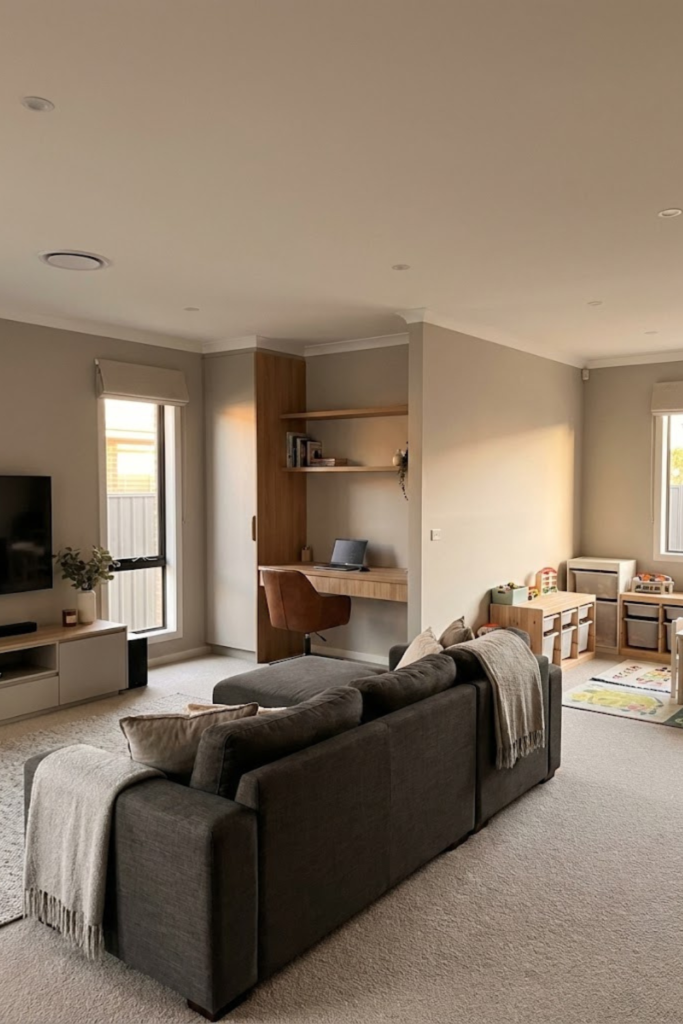
I used to love the idea of “Open Concept.” Then I had kids. Now, open concept just means “I can hear the TV, the dishwasher, and the video games all at once.” It creates a lot of noise and visual clutter. In 2026, we are fixing this with something called “Broken Plan” living. It isn’t about building new walls or closing doors; it is about using your furniture to create little zones. As a teacher, I know that classrooms have “stations” for a reason. You can’t do everything in one big pile. Your living room needs stations too if you want to keep your sanity.
The Sofa is Your New Wall
The easiest way to break up a room is with your sofa. Most people push the couch right up against the wall, but that leaves you with a big, empty middle. If you pull it out into the room, the back of the sofa acts like a low wall.
I put a long, skinny console table right behind my sectional. Now, it is my “grading station.” I can sit there on a stool with my laptop and get work done while the kids are lounging on the sofa watching a movie. We are in the same room, but we aren’t on top of each other. It creates a physical barrier that mentally separates “work time” from “chill time.” It is a total game changer for anyone who works from home or just needs a spot to pay bills without leaving the family action.
Shelves Create “Soft” Barriers
You know those open cube shelves that are everywhere? Instead of putting them against the wall, try turning them perpendicular to the wall. Suddenly, you have a room divider. I did this to block off the “play zone” from the “adult sitting zone.”
The shelves hold all the toys, but because they are open, light still gets through. You don’t feel closed in like you would with a real wall. It just stops the toys from migrating across the entire floor. Well, mostly. Legos still find a way to travel, but it helps a lot. It gives the room structure so it doesn’t look like a bomb went off every time the kids play.
Furniture That Does Double Duty
If you have a smaller house, you can’t have furniture that just sits there looking pretty. It has to work for a living. I swapped my heavy coffee table for a big storage ottoman. It is soft, so no bumped heads for the little ones, but the lid pops off and you can dump all the blankets, controllers, and random clutter inside in five seconds.
It is great for when company drops by unexpectedly and you need to “fake clean” the room fast. This “broken plan” idea keeps the flow of the house open and airy, but it gives you back a little bit of order. It makes the space work for real life, not just for a photo.
5. Bold & Moody: Using “Ice Blue” or Teal for Calm
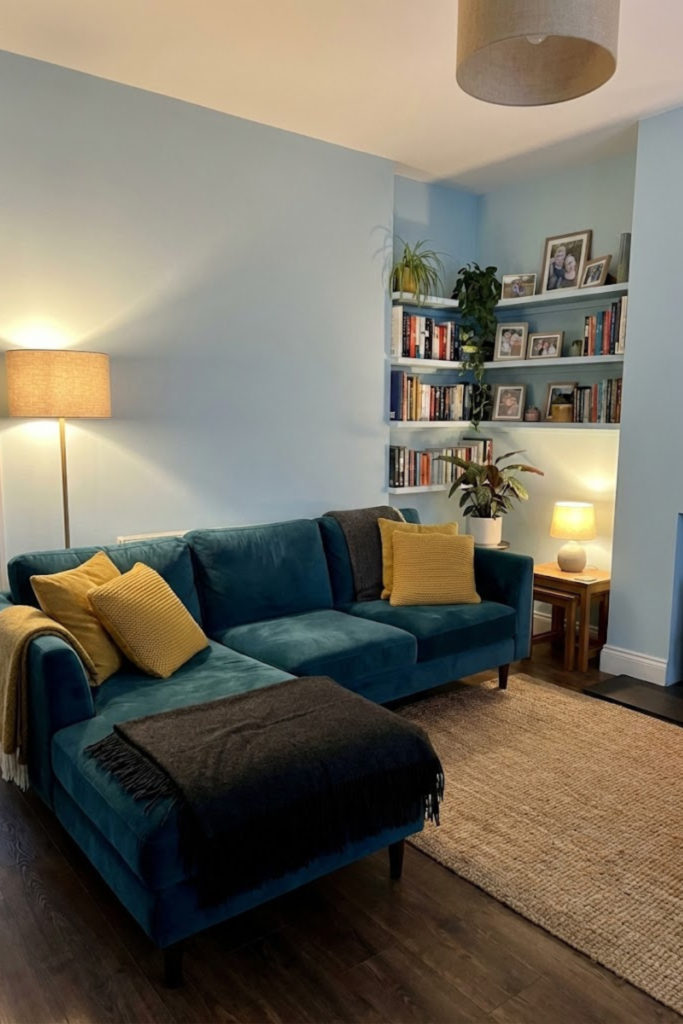
For years, I was afraid of dark paint. I thought if I painted my walls anything other than “Eggshell White” or “Revere Pewter,” my living room would look like a cave. I fell for the “all white everything” trend hard. But let me tell you, white walls in a family home are just a blank canvas for dirty fingerprints. In 2026, we are finally moving on. The big colors this year are “Ice Blue” and “Transformative Teal,” and they are exactly what exhausted parents need. It is about creating a mood, not just a room.
Ditch the “Sad Beige”
We have all seen those influencer houses that look like a cup of coffee with too much milk. They look pretty, but they feel sterile. When I come home after a day of teaching thirty energetic middle schoolers, I don’t want sterile. I want a hug.
Darker, cooler colors like teal or a dusty blue act like a “palate cleanser” for your brain. There is actual science behind it; blue lowers your heart rate. When I painted our living room a deep, moody blue, the whole energy changed. The kids stopped running around as much. It felt like a library or a cozy den. It signals to everyone that it is time to chill out. Plus, let’s be real: a dark wall hides a scuff mark way better than a white one. You aren’t constantly scrubbing with a magic eraser every weekend.
The Magic of “Color Drenching”
If you are going to go bold, do it the easy way. The trend right now is called “color drenching.” It sounds fancy, but it is actually the lazy painter’s dream. You paint the walls, the baseboards, the door frames, and even the ceiling trim all the exact same color.
I loved this because I didn’t have to use that blue painter’s tape to mark off the trim. You just dip the roller and go. It makes the room feel seamless and surprisingly bigger because your eye doesn’t get stopped by white lines everywhere. It looks expensive, like a boutique hotel, but it costs the same as a regular paint job.
Lighting is Key
Now, you can’t just paint the room dark and leave it. If you do that, it will feel like a dungeon. The trick is lighting. You need nice, warm lamps in the corners. When you have a moody wall color, the lamp light glows against it in a really beautiful way. It feels warm and inviting, especially at night for movie marathons.
Don’t rely on the big overhead light (the “big light” is the enemy of calm). Use floor lamps and table lamps to create little pools of light. It makes the “Ice Blue” look rich and cozy, not cold. It is a bold move, sure, but it pays off every single evening when you finally sit down.
6. The “Heirloom” Narrative: Vintage & Sustainable
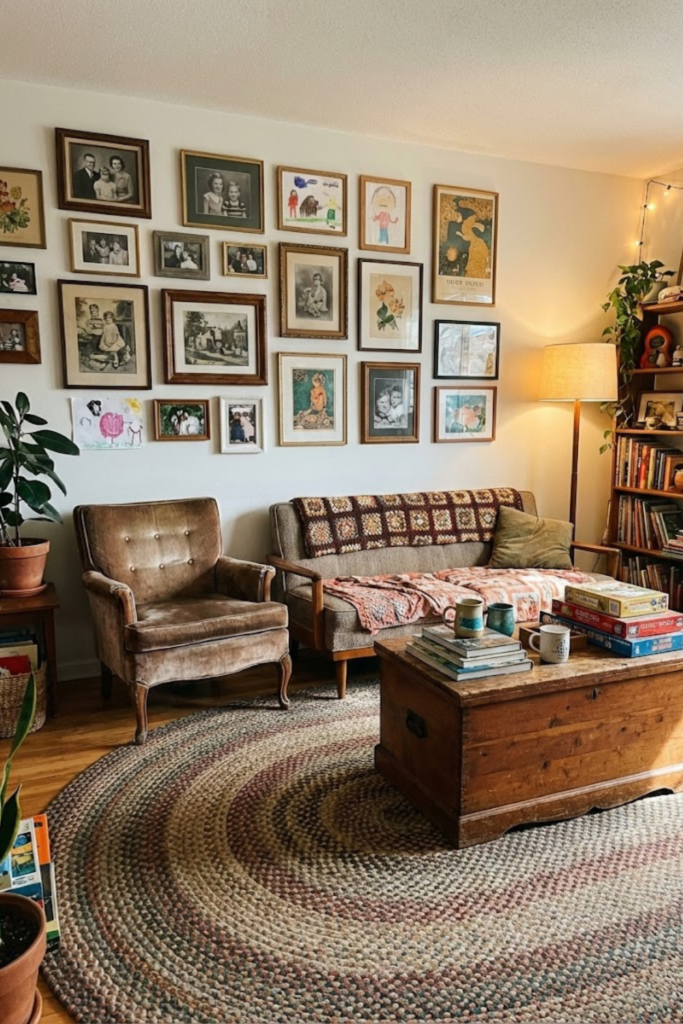
I remember buying a cute, cheap dresser for my daughter’s room a few years back. It looked great online, but after six months, the drawers fell off the tracks and the front started peeling. It was basically cardboard. That was my wake-up call. In 2026, we are stepping away from “fast furniture” that ends up in a dumpster. We are moving toward the “Heirloom” style. Now, don’t get scared by the word “heirloom.” It doesn’t mean expensive antiques you can’t touch. It means buying things that have already survived a few decades. If a solid oak table has lasted since 1970, it can probably survive my toddler banging a spoon on it.
Old Furniture is Built to Last
The biggest reason I switched to vintage is durability. New stuff is often made of particle board and glue. Old stuff? It is usually solid wood and metal. I found a heavy wooden chest at a thrift store for fifty bucks. It is now our coffee table. My kids climb on it, spill water on it, and drag toys across it. Because it is already beat up and distressed, a new scratch just blends in. It adds character instead of ruining the finish.
This takes the stress out of parenting. You don’t have to hover over your kids screaming, “Don’t touch that!” The furniture is tough enough to take it. It creates a home where you can actually live, not just look.
The “Quiet Maximalism” Vibe
There is a trend right now called “Quiet Maximalism.” It isn’t about clutter; it is about having things that tell a story. Instead of buying generic art from a big box store that says “Gather,” we frame weird postcards from trips or hang up a quilt my grandmother made.
It gives the room a soul. My students often ask me about the random knick-knacks on my desk, and it starts a conversation. Your home should do the same. When you mix a modern sofa with a vintage lamp, it looks collected and cool, like you didn’t try too hard. It stops your house from looking like a catalog page that everyone else has.
Teaching Kids to Value Things
As a teacher, I am always trying to teach lessons without sounding like I am teaching. Using vintage furniture is a sneaky way to teach sustainability. We talk about how we are saving a chair from the landfill. We talk about fixing things instead of throwing them away.
When we painted that thrift store chest together, the kids took ownership of it. They treat it better because they helped work on it. It shifts the mindset from “buy new” to “make do and mend,” which is a pretty good lesson for life, not just for decorating. It saves money, saves the planet, and saves your furniture from falling apart.
7. Smart & Hidden: The Tech-Integrated Space
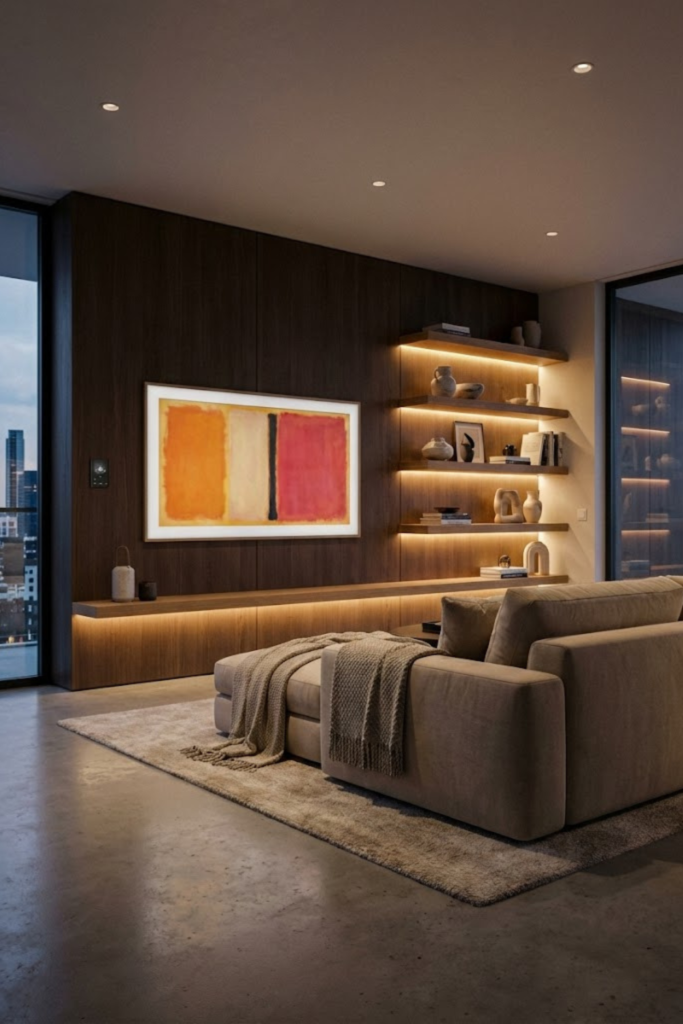
I love technology. I really do. I love that I can ask my house to play jazz or tell me the weather. But you know what I hate? Wires. Nothing ruins a beautiful room faster than a tangle of black cords hanging down the wall. It looks messy, and honestly, it drives me crazy. In 2026, the trend isn’t about getting rid of tech; it is about hiding it. We want the convenience, but we don’t want our living rooms to look like a Best Buy. As a mom, this is also a safety thing. If there is a loose wire, my kid will find it, and they will pull on it.
Lighting That Changes With Your Mood
The best upgrade I ever made was switching to smart bulbs. It sounds small, but it changes everything. In the afternoon, when the kids are doing homework on the coffee table, I have the lights set to a bright, cool white. It helps them focus. But the second the books are closed? I tap a button on my phone, and the room shifts to a warm, dim glow (around 3000K if you want to get technical).
It instantly tells their brains: “School is over. Relax.” It is like magic. You don’t need expensive rewiring to do this. You just screw in the bulbs. It stops that harsh overhead glare that makes everyone feel agitated. It creates a calm atmosphere without you having to yell “settle down” ten times.
The “Spaghetti” Problem
Let’s talk about the mess behind the TV. My husband calls it “the spaghetti.” It collects dust bunnies and looks terrible. But worse, it is dangerous. A toddler sees a dangling cord and thinks it is a toy. Next thing you know, the lamp is on the floor.
In this design, cable management is a priority, not an afterthought. We use paintable cord covers that stick to the wall and blend in. Or, we use furniture with built-in channels to hide the mess. It makes the room feel “quiet.” When your eyes aren’t catching on clutter and wires, you feel more rested. It removes that visual noise that adds to your stress levels without you even realizing it.
The TV That Pretends to be Art
The giant black rectangle on the wall is kind of an eyesore, right? It dominates the room. The big trend now is the “Frame” TV or using projectors. When the TV is off, it displays a picture of a painting or a family photo. It looks like a gallery wall, not a media center.
I love this because it stops the TV from being the boss of the room. It sits there quietly until you need it. It keeps the focus on the beautiful furniture and the people, rather than the screen. It is a sneaky way to keep the style high while still being able to binge-watch your favorite show after the kids go to bed.
Conclusion
We have covered a lot of ground here, haven’t we? From creating “conversation pits” with fluffy rugs to painting our walls that moody teal, the goal is always the same. We want a place where we can flop down after a long day of work or school and just feel good. As a teacher, I see how stressed kids are these days. They carry heavy backpacks and heavy worries. They need a safe harbor to come home to. And honestly, so do we.
Building a home that works for a family is a process. It is a marathon, not a sprint. I remember when I first moved into my house, I wanted everything finished immediately. I bought cheap stuff just to fill the space, and I regretted it later when it broke. If there is one thing I hope you take away from this, it is that it is okay to go slow. You don’t have to do all seven of these things this weekend.
Start small. Maybe this month you just clear off the coffee table and put out an “analogue bag” with some puzzles to see if it changes the vibe. Next month, maybe you tackle those messy wires behind the TV or switch to smart bulbs. Small changes add up to a big difference in how the room feels.
The “perfect” living room you see on social media often isn’t real. They probably moved a pile of laundry out of the frame just to take the picture. I know I have! The best living room is the one where you aren’t afraid to spill a little popcorn. It is the one where the sofa is comfy enough for a Sunday nap, the rug is soft enough for a wrestling match, and the lighting makes everyone look a little less tired than they actually are.
It is about creating a backdrop for your life. The scratches on the wood table? That’s from the time your son tried to build a ramp for his toy cars. The worn spot on the rug? That’s where the dog sleeps every single day. Those aren’t flaws; they are proof of life.
So, embrace the chaos a little bit. Use these design ideas to make the chaos manageable and stylish, but don’t try to scrub it away completely. A house without a little mess isn’t a home; it is just a building.
Call to Action If you found these tips helpful, please Pin this article to your Home Decor 2026 board on Pinterest! It helps me keep writing, and it saves these ideas for when you are finally ready to tackle that room makeover. Good luck with your decorating!