Ever stared at a pile of clothes on a chair and felt your stress levels spike? I have! It turns out, our environment plays a massive role in how well we sleep and how calmly we start our day. In fact, studies show that people with blue or calm-colored bedrooms actually get more sleep on average.
But let’s be real—minimalism in 2026 isn’t about living in a cold, empty white box anymore. It’s evolved. We are seeing a shift toward “soft minimalism,” where the focus is on warmth, texture, and intention rather than just emptiness. Whether you are working with a small apartment or a master suite, these modern minimalist bedroom ideas will help you curate a space that feels like a deep exhale. Ready to ditch the clutter and reclaim your sanctuary? Let’s dive in.
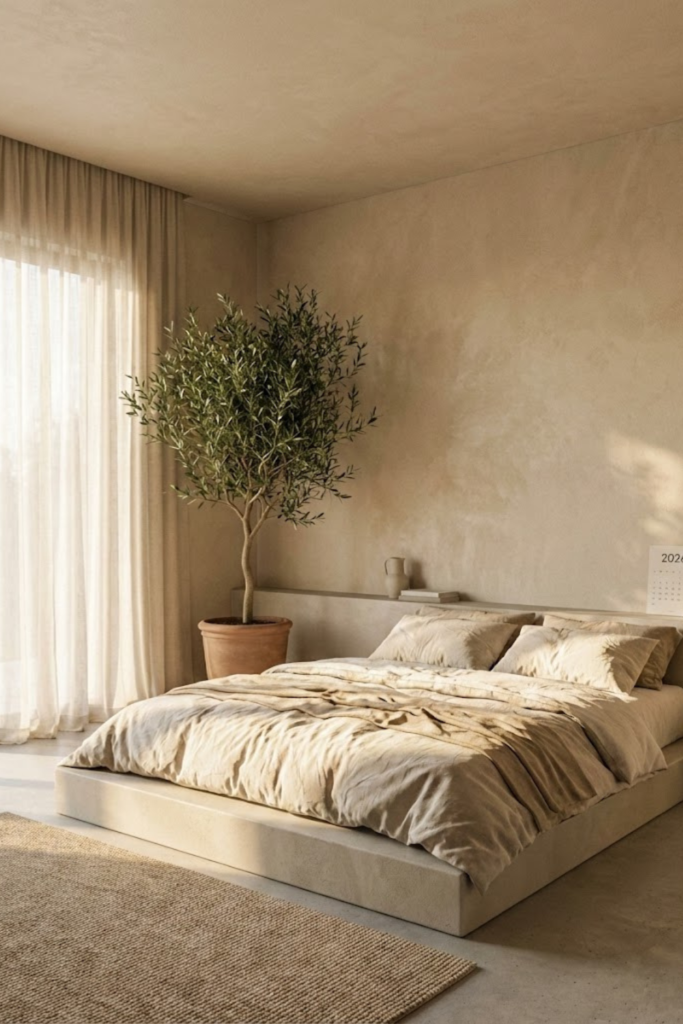
1. Embrace the “Warm Minimalist” Palette

I have to admit something embarrassing. A few years ago, I decided to go “minimalist” and painted my entire bedroom a color called “Stark White.” It was a disaster. I thought it would look clean and modern, but instead, it felt like I was sleeping in a dentist’s office. It was cold, sterile, and honestly, it stressed me out. That’s the thing about the old style of minimalism—it forgot about comfort.
In 2026, we are finally moving past that. We’re embracing the warm minimalist palette. This isn’t just about picking a color; it’s about how the room feels when you walk in. You want the space to feel like a warm hug, not a cold shoulder.
Breaking Up with Millennial Gray
For the longest time, everyone was obsessed with gray. I had gray walls, gray sheets, and gray pillows. It was too much. The biggest shift I’ve made recently is swapping those cool tones for earthy, grounding neutrals.
I’m talking about creamy taupes, soft caramels, and clay-toned beiges. These colors absorb light differently. They make the room feel settled. If you are scared of beige looking boring, try a shade like “Warm Eucalyptus” or a muted “Green Tea.” I painted an accent wall in a soft sage green last month, and it completely changed the vibe without feeling cluttered. It adds life without the chaos.
The Magic of Matte Finishes
Here is a trick I learned the hard way after buying the wrong paint finish. Always go matte. Glossy finishes reflect light and can make a modern minimalist bedroom feel shiny and plastic.
Matte paint soaks up the light. It softens the edges of the room. When I repainted my bedroom with a flat, matte clay color, the walls instantly looked velvety and expensive. It hides imperfections in the drywall too, which is a nice bonus if your house is older like mine.
Don’t Try to Match Everything
A common mistake is trying to match your bedding to your walls perfectly. I tried this, and it looked flat. The secret to a warm minimalist palette is monochromatic depth.
You want to layer different shades of the same family. Think of an oatmeal-colored rug paired with latte-colored sheets and a walnut bed frame. The variance creates visual interest so your eyes have something to do, but because it’s all in the same color family, it remains calm. It’s about building layers, not just emptying the room.
If you are staring at paint chips right now, put down the cool gray. Pick something that reminds you of coffee or sand. Your sleep schedule will thank you.
2. Low-Profile Platform Beds

I used to have this massive, high bed frame that I inherited from my grandmother. It was beautiful in a way, but it took up so much space visually. Every time I walked into my bedroom, it felt like the bed was shouting at me. It dominated the whole room. About two years ago, I finally swapped it out for a low-profile platform bed, and honestly, I couldn’t believe the difference. It felt like I had knocked down a wall or added an addition to the house.
Grounding the Space for Calm
If you are trying to get that modern minimalist vibe, the bed is the most important piece. A low bed sits closer to the ground, obviously, but the real magic is what it does to your vertical space.
Because the bed is lower, there is more distance between the top of the mattress and the ceiling. This simple trick makes your ceilings look way higher than they actually are. My bedroom isn’t huge, but lowering the furniture made it feel airy and open. It stops the room from feeling stuffy. It’s a game-changer if you live in a smaller house or apartment where every inch counts. You walk in, and your eyes can travel across the room without getting stuck on a giant footboard.
Saying Goodbye to Shin Bruises
Speaking of footboards, getting rid of mine was the best decision for my shins. We have all been there—stumbling to the bathroom in the dark and whacking a shin on the corner of the bed frame.
With a platform bed, you usually get clean lines and simple geometry. There isn’t a lot of extra “stuff” hanging off the edges. I looked for a frame that was flush with the mattress. It keeps the visual flow interrupted. When you are going for minimalism, you don’t want your furniture to have too many curlicues or heavy ornamentation. You want it to disappear a little bit. It makes the whole room feel quieter.
Softening the Edges
A lot of people think minimalism means hard, uncomfortable edges. But I actually went with a platform bed that has a soft, upholstered headboard. It’s a linen material in a light oatmeal color.
I think this is key for 2026. We aren’t doing the “sleeping on a concrete block” look. We want comfort. The low height gives you the modern look, but the fabric brings in that warmth we talked about earlier. If you go for a floating design—where the legs are hidden—it looks even sleeker. It makes vacuuming underneath a bit of a challenge sometimes, but the look is worth it. It just feels like the bed is hovering, which is pretty cool and very relaxing to look at after a long day teaching.
3. Create a “Quiet Corner” Reading Nook

I used to have a bad habit of bringing my work into bed with me. I’d sit there with a stack of papers to grade, and before I knew it, my relaxing sanctuary turned into a stressful office. I realized I needed a separation. I needed a spot in the bedroom that was strictly for unwinding, but not for sleeping. That is where the idea of the “Quiet Corner” came from, and it’s a huge part of the minimalist movement in 2026.
You might think you don’t have enough space for this. I thought the same thing. My bedroom isn’t a palace. But I cleared out a corner that was just collecting dust bunnies and an old laundry hamper, and I made it into my favorite part of the house.
Intentional Zoning with Minimal Furniture
The trick here is to not overfill the space. You are trying to create a “pause” button for your day. You don’t need a giant bookshelf or a massive recliner.
I bought a simple, sleek accent chair. It has clean lines, but the fabric is a soft, nubby boucle that feels great to sit on. Next to it, I put a tiny, round side table—just big enough for a cup of herbal tea and my glasses. That’s it. By keeping the furniture light and simple, the corner doesn’t feel crowded. It feels like a little escape pod. If you are really tight on space, a simple bench at the foot of the bed can do the same job. It gives you a place to sit and put on your socks or read a chapter of a book without messing up your made bed.
Lighting the Nook
Lighting was the hardest part for me to figure out. I didn’t want a floor lamp taking up precious floor space, and I didn’t want a cord trailing across the room.
I ended up installing an articulated wall sconce. It’s a light attached to the wall that has an arm you can move. It is perfect because I can pull it close when I’m reading and push it back against the wall when I’m done. It looks very modern and keeps the floor completely clear, which makes the room look bigger. Having a distinct light source for this corner also helps your brain understand that this is a separate zone from the sleeping area. It helps me switch gears from “awake” to “rest” without going straight to sleep mode. It’s a small change, but it makes the room work much better for actual living.
4. Prioritize Texture Over Decor

I used to think a room was finished only when every single shelf was full. I had little figurines, candles, and picture frames everywhere. Honestly, dusting was a total nightmare! I hated it. Then I realized that in a modern minimalist bedroom, the room itself should be the decoration. You don’t need a hundred little things to make a space look good. You just need the right surfaces.
This is what people are calling “soft minimalism” in 2026. It is my favorite trend because it stops the room from feeling empty or boring, but you don’t have to buy a bunch of junk to achieve it.
Walls That Feel Alive
The biggest change I made was to my walls. I used to just slap on a coat of flat white paint and call it a day. But that can look a little dead.
Now, I’m seeing walls that actually have some feeling to them. I tried a “lime wash” paint on the wall behind my bed, and it’s amazing. It has this subtle, cloudy texture that looks like old plaster. It adds so much character and depth that I didn’t feel the need to hang a big piece of art there. The wall is the art. If painting sounds like too much work, you can get the same vibe with some wood paneling or even a textured wallpaper. It makes the room feel cozy and grounded, like a really nice hotel room.
The “Soft” Layering Trick
Since you aren’t using a lot of colors, you have to use different fabrics to keep things interesting. If everything is just smooth cotton, it looks flat.
I started layering my bedding, and it made the bed look ten times more expensive. I use a linen duvet cover because it has that nice, crinkled look that feels relaxed. Then I throw a chunky wool blanket at the end of the bed. Even though they are both in the same creamy color family, the difference between the rough wool and the soft linen catches your eye. It makes you want to dive right in.
Bringing in Natural Materials
To keep the room from feeling like a hospital, you need some natural elements. I swapped my shiny metal lamp for one with a stone base. The rough stone contrasts really well with the soft bedding.
It’s all about balance. If you have a smooth wood floor, add a fluffy rug. If you have sleek walls, get a headboard with some nubby fabric. These natural touches—wood, stone, wool—bring a warmth that plastic or metal just can’t match. It stops the minimalist design from feeling cold and clinical, which is definitely not what you want when you are trying to sleep.
5. Master Hidden Storage & Floating Furniture
I live in a house that was built in the 70s, and let me tell you, they did not believe in closets back then. Storage has always been a battle for me. In a minimalist bedroom, you can’t have piles of laundry or boxes of winter coats sitting out. It kills the vibe instantly. The secret to making a room look clean when you actually own stuff is hidden storage. It’s about being sneaky with your furniture.
Floating Nightstands
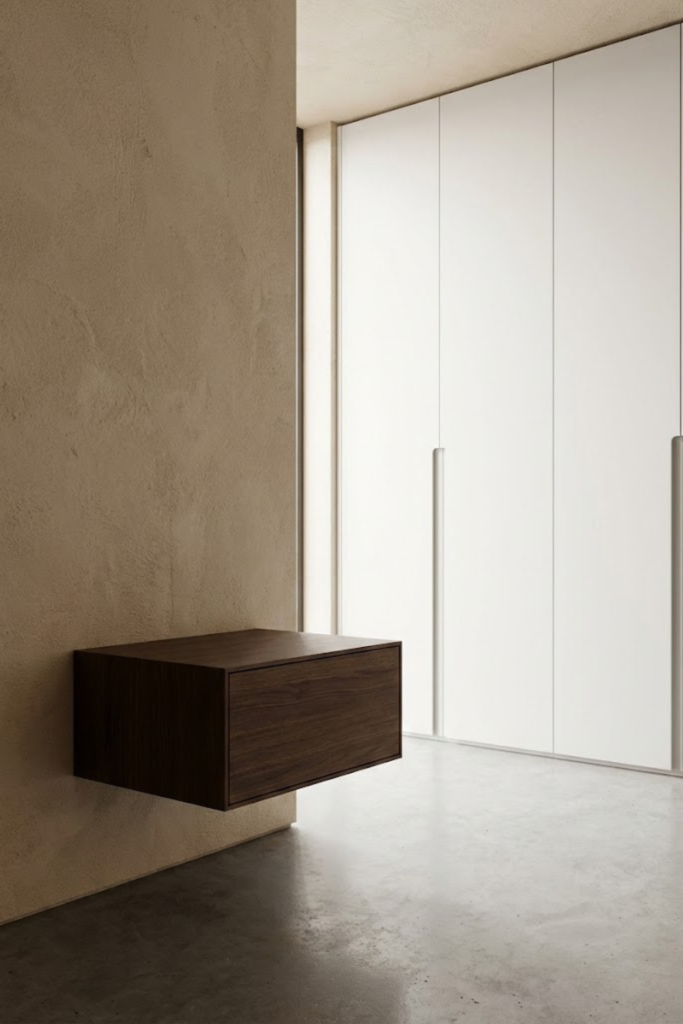
One of the best things I did for my small bedroom was getting rid of my clunky bedside tables. I replaced them with floating nightstands that attach directly to the wall.
Because they don’t have legs touching the floor, the room feels so much bigger. It tricks your eye. You can see more of the floor, so your brain thinks, “Wow, this is a spacious room.” Plus, it makes vacuuming a breeze—no more trying to jam the vacuum cleaner around dusty table legs. It’s a small change that makes the room feel lighter and airier, which is exactly what you want for a restful sleep.
The Under-Bed Secret
If you have a bed, you have storage. You just have to use it right. I used to just shove random boxes under there, and it was a mess. Now, I use a platform bed with built-in drawers.
It is a life-saver. I keep all my winter sweaters and extra blankets in there. If you don’t want to buy a new bed, you can just get some rolling bins. But here is the key: get bins that match your bed frame or the floor so they blend in. You don’t want to see bright blue plastic peeking out. Keeping that stuff hidden means my closet isn’t bursting at the seams, and the rest of the room stays clutter-free.
The “One-In, One-Out” Rule
This isn’t really a furniture tip, but it’s the only way I keep my storage from overflowing. I have a rule: if I buy something new, something old has to go.
If I get a new pair of shoes, an old pair gets donated. It sounds strict, but it stops the “clutter creep.” We all have that chair in the bedroom that ends up covered in clothes we’re “too tired to hang up.” By limiting what I own to what actually fits in my hidden storage, I don’t have that pile anymore. Everything has a place, and usually, that place is out of sight.
Wardrobe Walls
If you are doing a bigger renovation, think about a wardrobe wall. I have seen these floor-to-ceiling closets that just look like a wall. They have flat doors with no handles—you just push to open them.
It’s amazing because it holds a ton of stuff—clothes, shoes, luggage—but when it’s closed, it just looks like a calm, white wall. It completely hides the chaos of your wardrobe. It’s the ultimate trick for a minimalist bedroom because it removes all the visual noise of your clothing.
6. Biophilic Accents (Bring the Outdoors In)
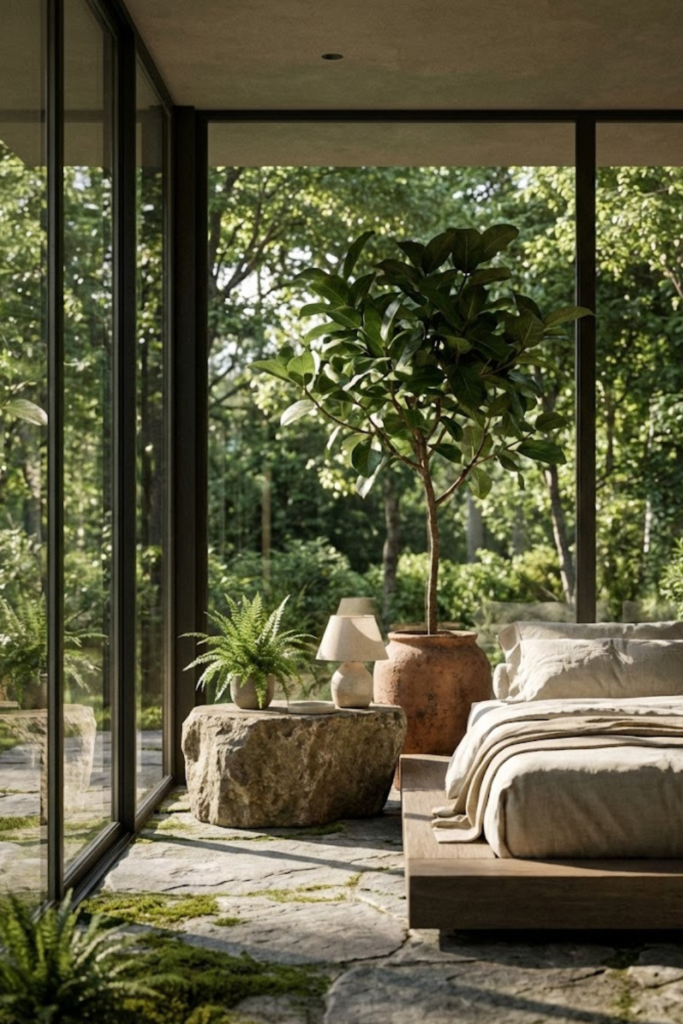
I used to think “biophilic design” was just a fancy word for buying a houseplant. But after spending all day in a classroom with fluorescent lights and linoleum floors, I realized I needed more than just a pot of dirt on my windowsill. I needed my bedroom to feel like a breath of fresh air. In 2026, bringing nature inside is a huge part of the minimalist look because it adds life without adding clutter.
It’s about blurring the line between your room and the world outside. When you do it right, your bedroom feels less like a box and more like a sanctuary.
One Big Plant vs. The Jungle
A few years ago, I went through a phase where I bought a tiny succulent every time I went to the grocery store. My dresser was covered in twenty little pots. It looked messy, and honestly, watering them all was a pain.
For a modern minimalist vibe, the trick is to go big. I got rid of the clutter and bought one large Olive tree in a simple terracotta pot. It sits in the corner and looks like a piece of living sculpture. It draws your eye up and adds a splash of green, but because it’s just one item, the room still feels calm. Plus, looking at greenery actually lowers your heart rate. It’s a science fact! So, stop buying the tiny plants that die in a week and invest in one tree that makes a statement.
Chasing the Natural Light
You can have the best furniture in the world, but if your room is dark, it won’t feel right. Minimalism loves light. It makes the white space feel purposeful.
I used to have heavy, blackout curtains because I thought I needed them to sleep. But they made the room feel heavy and closed off during the day. I swapped them for light, sheer linen curtains. Now, the sunlight filters in softly in the morning. It wakes me up gently instead of a jarring alarm. If you need darkness for sleep, you can get hidden roller shades that disappear during the day. The goal is to maximize that natural light so the room feels airy and connected to the outdoors.
Ditching the Sharp Corners
Have you ever noticed that there are no straight lines in nature? Trees are round, rivers curve, and rocks are smooth. But our bedrooms are usually full of squares—square bed, square rug, square dresser.
To bring that organic feel inside, I started adding curves. I hung a round mirror instead of a rectangular one. I got a small, round ottoman. These “organic shapes” soften the room. They break up all the rigid lines and make the space feel more fluid and natural. It’s a subtle change, but it makes the room feel less rigid and more welcoming, kind of like being outside.
Raw Materials Ground the Room
Finally, look at your materials. I swapped a plastic laundry hamper for a woven wicker one. I put a raw wood tray on my dresser. Using materials that come from the earth—like wood, stone, clay, or wool—grounds the space. It adds texture that you want to touch. It keeps the minimalist look from feeling too “space-age” and brings it back down to earth.
7. Layered, Warm Lighting

I used to have one light in my bedroom: that big, glass “boob light” flush against the ceiling. Every time I flipped the switch, it felt like being interrogated. It was harsh, bright, and unflattering. I hated it. It wasn’t until I started reading up on design that I learned about “layered lighting.” It sounds technical, but it just means having different lights for different jobs.
In a modern minimalist bedroom, lighting isn’t just about seeing where you are going. It’s about setting a mood. You want to be able to change the feel of the room without painting the walls.
Ditch the “Big Light”
The first thing I did was stop using that overhead light. In fact, I pretend it doesn’t exist. For a calm, minimalist vibe, you need soft, ambient light.
I bought a couple of floor lamps with paper shades. They diffuse the light, so it glows instead of glares. It makes the whole room feel softer and cozier. It’s hard to relax when a bright bulb is shining directly in your eyes. By moving the light down to eye level, the room feels more grounded. It’s a simple switch, but it instantly makes the space feel more expensive and put-together.
Wall Sconces for the Win
We talked about floating nightstands earlier, and wall sconces go hand-in-hand with them. I installed two sconces on either side of my bed.
They are great because they don’t take up any table space. I can have my book and my water glass on the nightstand without knocking over a lamp. Plus, they give me focused light exactly where I need it for reading. I don’t have to light up the whole room just to read a few pages before sleep. It keeps the rest of the room in the shadows, which helps my brain get ready to shut down.
The Magic of Cove Lighting
If you want your bedroom to look like a high-end hotel, try cove lighting. This is where you hide a light strip so you see the glow, but not the bulb.
I put a simple LED strip behind my headboard. At night, I turn it on, and it creates this soft halo of light against the wall. It looks incredibly cool and modern. It adds depth to the room without adding any physical clutter. It’s just light and shadow. You can even put them under the bed frame to make it look like the bed is floating.
Smart Bulbs for Better Sleep
Finally, I swapped my regular bulbs for smart bulbs. I know, technology can be annoying, but this is worth it.
I have them set to change color temperature. In the morning, they are a crisp, white light to help me wake up. But as the sun goes down, they shift to a warm, amber color. It mimics the sunset. This warm light doesn’t mess with my sleep hormones like blue light does. By the time I’m ready for bed, the room is bathed in a golden glow that makes falling asleep so much easier.
Conclusion
So, there you have it. That is how I turned my chaotic bedroom into a place where I actually want to sleep. It wasn’t about throwing everything away or living in an empty white box. It was about making choices that actually make sense for my life.
We talked about warming up the paint colors so it doesn’t feel like a hospital. We looked at swapping clunky furniture for low beds and floating nightstands to make the room feel bigger. And please, if you do only one thing from this list, turn off that big overhead light and get a lamp! It changes everything.
I hope these ideas help you. You don’t have to do all of them at once. Just pick one, like buying a nice plant or clearing off your nightstand this weekend. It makes a difference. Creating a space that feels good is a process, not a race.
If you found these tips helpful, please save this pin to your “Dream Home” or “Bedroom Decor” board on Pinterest! It helps me out a lot, and it makes it easy for you to find these ideas again when you are ready to start decorating.