You know that feeling when you walk into a room and your shoulders just instantly drop? That’s the power of a truly well-designed, simple living space. But let’s be real—achieving that effortless look is rarely effortless. I’ve spent years analyzing home trends, and I can tell you that 2026 is shaping up to be the year of “sensory comfort” and intentional living. Gone are the days of stark, cold minimalism; we are moving toward spaces that hug you back.
Did you know that recent design reports indicate a massive shift towards “cocooning” architecture, with a focus on rounded furniture and earth-derived palettes?. It’s fascinating! In this article, I’m going to walk you through 7 simple living room designs that blend functionality with this new wave of warmth. whether you’re working with a tiny apartment or a sprawling open plan, these ideas will help you cut the clutter and turn your house into a sanctuary. Let’s dive in!
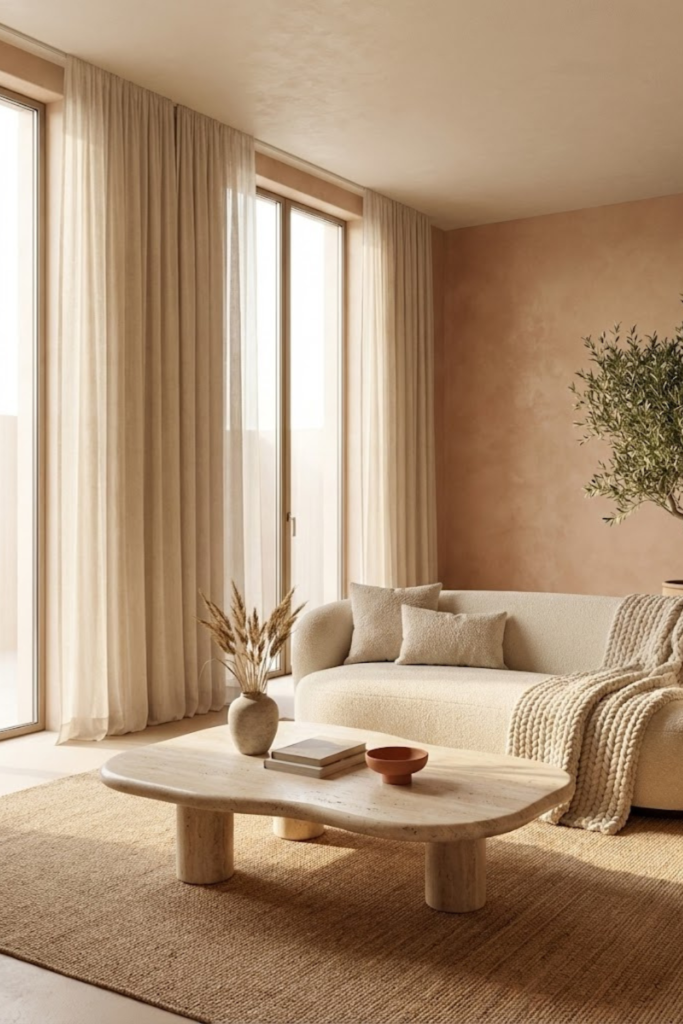
1. The “Quiet Luxury” Minimalist

I’ve gotta admit, when I first heard the term “Quiet Luxury,” I rolled my eyes a bit. It sounded like something only for people with fancy penthouses or endless budgets. But after messing around with the layout in my own den, I totally get the hype now. It isn’t about spending a fortune; it is about picking things that look and feel solid. It’s minimalism, sure, but it doesn’t feel cold or empty like those stark white rooms from ten years ago. It feels warm and expensive, even if you bought the throw pillows on sale.
It’s All About the Textures
If you want this look, you have to stop looking at wild patterns and start looking at what things are made of. In 2026, we are seeing a lot of what designers call “artisanal surfaces.” This basically means wood that looks like wood, with knots and grain, not that shiny fake stuff. I swapped out my old glossy coffee table for a matte smoked oak one, and wow, the difference was huge.
You should look for honed marble—that’s the kind without the shiny finish—or unlacquered brass. These materials age well. They get little scratches or spots over time, which actually makes them look better. It gives the room some character, like it’s been there forever. You want to walk into the room and want to touch everything. If you see a velvet chair, it should look soft, not stiff.
The “No-Color” Color Palette
Okay, don’t get mad at me, but you might need to ditch the bright orange accent wall. Quiet Luxury is all about monochromatic colors. We are talking layers of cream, beige, oatmeal, and maybe a soft brown. I know, it sounds boring on paper. But when you layer these shades, it’s super calming.
Think about it like a really nice outfit. You might wear a cream sweater with tan pants and a brown coat. It looks put together, right? Your living room should do the same. It creates a space where your eyes can just rest. You aren’t distracted by loud colors, so you notice the nice furniture more.
Make the Tech Disappear
Nothing ruins a fancy vibe faster than a bunch of black wires tangling up behind the TV. This style is big on “visual silence.” That means hiding the mess. I used some simple cord covers painted to match my wall color. It took me like an hour, and it made the whole TV area look so much cleaner.
Also, try to keep gadgets out of sight. If you have speakers, tuck them into a bookshelf or get ones that blend in. The goal is that when you walk in, you see beautiful furniture, not your wifi router blinking at you.
Low and Comfy Furniture
One last tip I tell everyone: get lower furniture. A low-profile sofa makes the ceilings feel higher and the room feel bigger. It invites you to sit down and actually relax. You don’t want stiff, high-backed chairs here. You want things that look like they are hugging the ground. It’s a small trick, but it changes the whole feeling of the space to be more laid-back but still classy.
2. Japandi 2.0: Warm & Textural

I remember when the Japandi trend first hit the scene a few years back. Everyone was excited about mixing Japanese design with Scandinavian stuff. But honestly? A lot of those rooms felt a bit… empty to me. Like nobody actually lived there. It was all straight lines, zero clutter, and kind of cold. But 2026 has brought us what I call “Japandi 2.0,” and I am here for it. It has that same clean look, but it’s messier in a good way. It feels warmer and way more inviting.
Embracing the Imperfect
The fancy word for this is “wabi-sabi,” but I just call it “loving the cracks.” In the old version of this style, everything had to be perfect and smooth. Now, it is all about things that look handmade. I bought this ceramic vase last month that is slightly lopsided, and it is my favorite thing in the room. It adds character.
You want to look for wood that has knots in it or bowls that look like someone made them in a pottery class. If a piece of furniture has a little scratch or the paint is fading, don’t rush to fix it. That is part of the charm now. It creates a vibe that feels lived-in, unlike those factory-made pieces that all look exactly the same. It makes your home feel like yours.
Wood Slats are Everywhere
If you want to make your living room feel cozy without buying a ton of stuff, look into wood slats. I put some up on the wall behind my TV, and it completely changed the sound in the room. It stopped the echo, which was a nice surprise. Plus, the vertical lines make the ceiling look way higher.
You don’t need to do a whole wall, either. Even just a small section adds this nice, warm texture that plain paint just can’t do. I think light oak works best for this to keep it airy, but walnut is great if you want it moodier. It is a pretty simple project, too. I did mine on a Saturday afternoon with just a few basic tools.
Get Low to the Ground
This might feel weird if you are used to big, puffy sofas, but Japandi is all about being closer to the floor. It is called “floor culture.” I swapped my tall armchair for a low lounge chair, and it surprisingly makes the room feel so much calmer. It forces you to slow down.
You don’t have to sit on the actual floor (unless you want to!), but picking furniture with shorter legs helps keep the sightlines open. It makes a small room feel huge. To make sure it doesn’t feel like a college dorm, just make sure the cushions are thick and high quality.
Soft Lighting Only
Forget bright overhead lights. They are the enemy of this style. You want that soft, paper lantern look. I got a cheap paper floor lamp from a regular store, and it gives off this gentle glow that makes everyone look good. It is not about lighting up the whole room like a stadium; it is about creating little pools of light where you sit. It is super relaxing after a long day at work.
3. The Organic Modern “Cocoon”
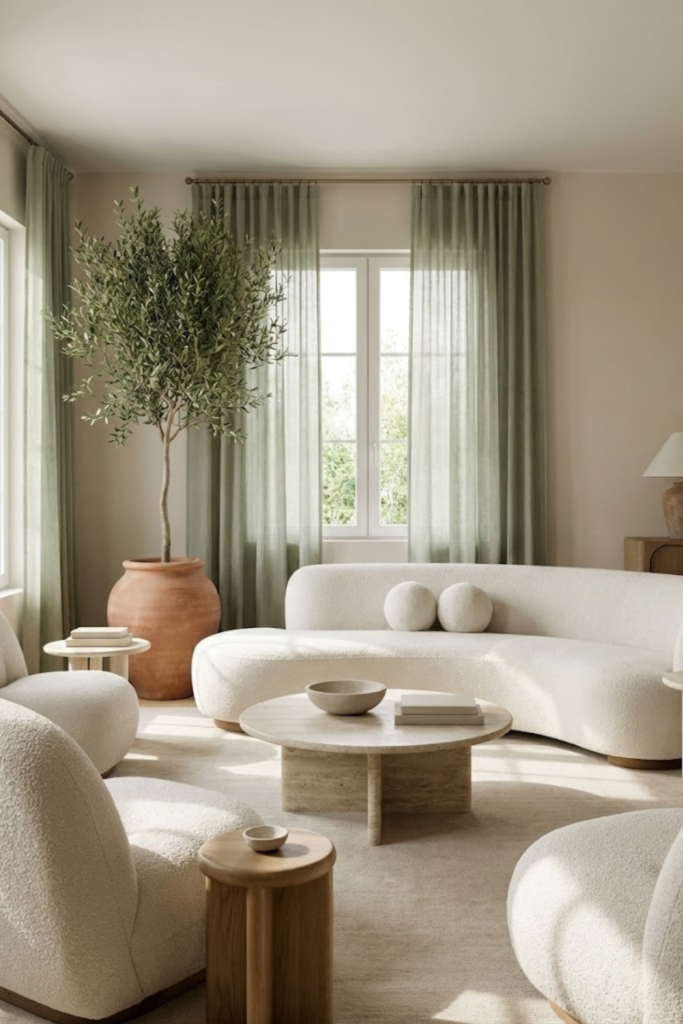
I have noticed a huge shift lately in how people want their homes to feel. For a long time, everything was about looking impressive or sharp. But now? We just want to feel safe. We want to come home and feel like the house is giving us a big hug. That is where this “Organic Modern Cocoon” idea comes from. It rejects those sharp, pointy corners we used to see everywhere in favor of shapes that flow. It is about building a space that feels soft, safe, and connected to the earth.
Curves Are Your Best Friend
If you look around your living room right now, count how many sharp corners you see. Probably a lot, right? The biggest change with this style is swapping those out for curves. I used to have this rectangular glass coffee table that I was constantly bumping my shins on. I finally traded it for a round, wooden drum table, and the whole energy of the room changed.
It is not just about safety, though that helps. Curved sofas and “croissant” style armchairs soften the look of a room. They make the space feel less rigid. When furniture curves, it encourages conversation because you are naturally turned towards people. It feels more human. You don’t need to buy a whole new couch to do this; even adding a round ottoman or a circular rug can help break up all the straight lines.
Bringing the Outside In
We used to think “bringing nature in” just meant putting a potted plant in the corner and calling it a day. But this style goes deeper. It is about blurring the line between your living room and the outdoors. If you have big windows, keep the curtains open or use very sheer fabrics so you can always see the trees or sky.
I like to use what designers call “biophilic design,” which is just a fancy way of saying we feel better when we are near nature. Try using larger plants, like a big olive tree or a fiddle leaf fig, as a main piece of furniture rather than just a decoration. The green color creates a natural calm that no paint color can really match. It breathes life into the space, literally.
Textures You Want to Touch
In a “cocoon” room, how things feel is just as important as how they look. I always tell people to do the “touch test.” If you walk past a chair and don’t want to run your hand over it, it probably doesn’t belong here. We are seeing a lot of nubby fabrics like bouclé (that loop yarn fabric) and faux shearling.
I threw a heavy, knitted blanket over my sofa last winter, and it became the most popular spot in the house. You want materials that invite you to sit down. Think about raw materials too, like rattan or jute rugs. They add a bit of roughness that balances out the soft cushions, so the room doesn’t feel too precious. It grounds the space and makes it feel real.
Keeping it Raw
Finally, stay away from things that look too polished or plastic. The Organic Modern look loves raw wood. If you can find a side table that still shows the tree rings or has a live edge, that is perfect. These natural imperfections remind us of the outdoors and help us relax. It is less about having a showroom house and more about having a sanctuary.
4. Earth-Toned & Grounded
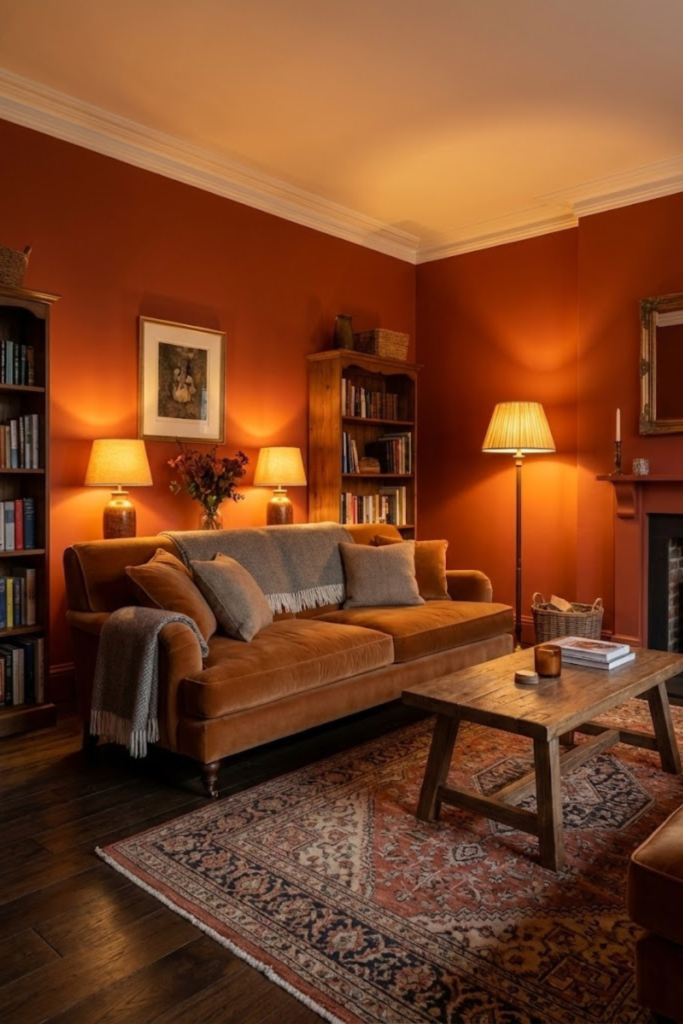
I grew up thinking brown was the color of old, dusty houses from the 70s. But lately? I have completely changed my mind. We spent so many years painting everything stark white or that chilly grey color, and frankly, I think we all got a little tired of living in what felt like ice boxes. This year, it is all about what some designers are calling “delicious browns” and earthy terracottas. It creates a space that feels grounded, like you have your feet on the solid earth even if you live in a high-rise apartment.
The Magic of “Color Drenching”
This is a big phrase being thrown around right now, but the concept is actually super simple. It just means painting everything—the walls, the trim, the baseboards, and yes, even the ceiling—the same color. I know, it sounds a little scary. I tried this in a small den recently with a deep caramel color. I was terrified it would look like a dark cave.
But actually? It did the opposite. Because there are no white lines breaking up the walls and ceiling, the corners sort of blur. It made the room feel endless and incredibly warm. It wraps around you like a blanket. If you are nervous, start with a lighter shade, like a sandy beige or a soft clay color. It gives you that cozy feeling without being too dark.
Brown is the New Grey
For the longest time, grey was the safe choice for everything. But now, warm neutrals are taking over. Think about colors like mocha mousse, olive green, or rust. These colors have depth. They change when the sun hits them. A grey wall just sits there, but a terracotta wall glows in the afternoon light.
If you aren’t ready to paint your whole room, try swapping out your furniture. A velvet sofa in a rich rust color can be the main star of the living room. It hides stains way better than a white one (which is great if you have kids or pets), and it instantly makes the room feel expensive and inviting.
Stone isn’t Just for Outdoors
We usually think of terracotta tiles or rough stone for patios, but bringing them inside is a huge trend. I’ve seen some amazing living rooms recently that use terracotta tiles on the floor. It brings a vacation vibe right into the house. It feels very Mediterranean and relaxed.
If ripping up your floors sounds like a nightmare, just look for a coffee table with a natural stone top, maybe in a brown marble or a travertine. It adds that natural, earthy element without the construction mess.
Less Stuff, More Warmth
The best part about this style is that the color does most of the work for you. When your walls are a rich, beautiful color, you don’t need to hang a million pictures or fill every shelf with knick-knacks. The warmth of the room is the decoration. It lets you keep the layout simple and uncluttered, which is exactly what we need to relax.
5. The “Intelligent Modular” Space
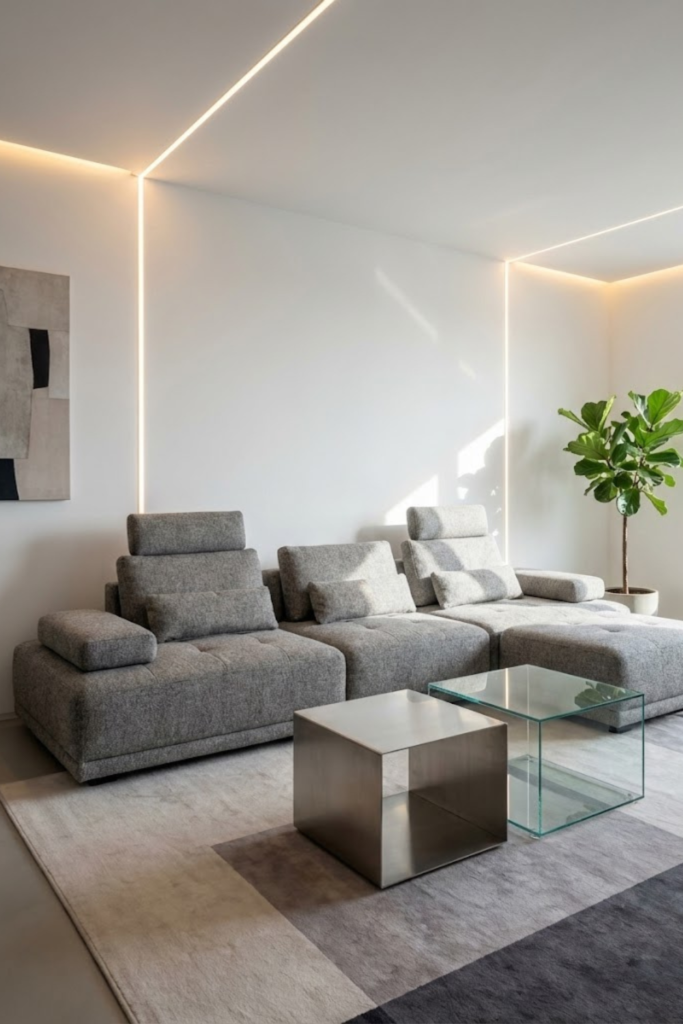
I used to live in this tiny apartment in the city, and let me tell you, it was a constant battle. I wanted a nice living room to host movie nights, but I also needed space to do yoga and somewhere for my sister to crash when she visited. For the longest time, I thought I just had to choose one. But that is where “Intelligent Modular” design saves the day. It sounds super technical, but it really just means buying furniture that isn’t stuck in one shape. It is perfect for smaller homes because the room grows and shrinks with your needs.
The Sofa That Does It All
The old school sectionals were huge, heavy beasts that you could never move. The new wave of modular sofas is totally different. I recently helped a friend pick out a grey sectional where the backrests actually move. You can slide them back to make a deep lounging bed for watching TV, or push them forward when you want to sit up and drink coffee.
Some of them even separate completely. You can have a big L-shape for a party, and then break it apart into separate chairs when you want the floor space open. It is like playing with LEGOs for adults. It solves that problem of “not enough seats” without filling the room with heavy chairs that you trip over.
Tables That Play Hide and Seek
If floor space is tight, you cannot have a giant coffee table taking up the middle of the room. I am a huge fan of nesting tables. These are usually a set of two or three small tables that stack under each other. When it is just you, they take up hardly any room. When guests come over, you pull them out and suddenly everyone has a place to put their drink.
I really like the glass and steel ones we are seeing now. They have a bit of an industrial look—clean and sharp. Because they are see-through, they don’t block your view of the floor, which tricks your brain into thinking the room is bigger than it actually is.
Creating Zones Without Walls
In a small living room, you often have to do everything in one square. You might work, eat, and relax in the same spot. Modular furniture helps you create “zones.” You can use an open bookshelf as a divider to separate your desk from your sofa. It gives you privacy without blocking the light.
I set up a reading nook in my corner that transforms into a guest sleeping area. I use a modular ottoman that pushes against the chair to make a chaise lounge. It’s practical. You stop feeling like you are living in a bedroom and start feeling like you have a multi-purpose home.
Keeping it Clean and Industrial
To make this work, you have to keep the style simple. This design leans a bit towards the industrial side—think black metal legs and straight lines. You don’t want big, puffy rolled arms on the sofa because they waste space. You want sleek profiles.
It keeps the visual clutter down. When your furniture is doing double duty, you don’t need as much of it. It feels very organized. You know that feeling when everything has a place? That is what this style gives you. It stops the apartment from feeling messy and makes it feel smart.
6. Coastal Modern Ease

I have always loved the ocean. There is something about the sound of the waves that just fixes a bad day. But for a long time, trying to bring that feeling home meant buying cheesy decor. You know what I’m talking about—pillows with anchors on them, signs that say “Beach House,” and jars full of seashells. It always felt a little tacky to me. Thankfully, 2026 has brought us “Coastal Modern Ease.” It captures the feeling of the beach—the breeze, the light, the calm—without looking like a souvenir shop.
The “New” Blue
The biggest change here is the color palette. We aren’t using bright turquoise or navy blue anymore. It’s softer now. Designers are calling it “dusty blue” or muted teal. It looks like the ocean on a cloudy day, or sea glass you find in the sand. I painted my guest room in a soft, dusty blue recently, and it is instantly relaxing.
You want to pair these blues with a lot of white and sandy beige. It keeps the room feeling airy. If you are afraid of color, just stick to white walls and use a dusty blue sofa or a couple of throw pillows. It gives you that water vibe without being loud. It creates a space where you can breathe.
Fabrics That Move
To get that breezy beach feeling, you have to look at your fabrics. Heavy velvet or leather just doesn’t work here. You want things that look like they could blow in the wind. Linen is my absolute favorite for this. I swapped out my heavy curtains for sheer white linen ones, and I let them pool a little bit on the floor.
It looks casual, not messy. When the window is open and the breeze catches the curtain, it is magical. It brings movement into the room. For furniture, think about slipcovers. A white or oatmeal slipcovered sofa looks comfortable and easy to clean. If you get sand (or crumbs) on it, you just wash it. It fits the laid-back lifestyle perfectly.
Lighten Up the Wood
Dark wood can feel very serious and heavy. Coastal Modern is all about light. You want to choose woods that look like they have been sitting in the sun. Whitewashed wood, light oak, or even bleached driftwood tones are perfect.
I have a coffee table made of pale, unfinished wood, and it bounces the light around the room instead of absorbing it. It makes the whole living room feel brighter. If you have dark floors and can’t change them, don’t worry. just throw down a large, light-colored rug. A jute or sisal rug works great because it adds that natural, sandy texture under your feet.
One Big Piece, Not Clutter
Here is where a lot of people go wrong. They try to fill every shelf with beachy knick-knacks. Don’t do it! This style is clean. instead of twenty small shells, find one large, beautiful thing. Maybe it is a big piece of driftwood you found on a walk, or a large glass vase that looks like sea glass.
I have a single large painting of a horizon line on my wall. That’s it. It draws your eye and sets the mood without making the room feel busy. The goal is to create a space that feels as open and uncluttered as the beach itself.
7. The Gallery-Soft Loft
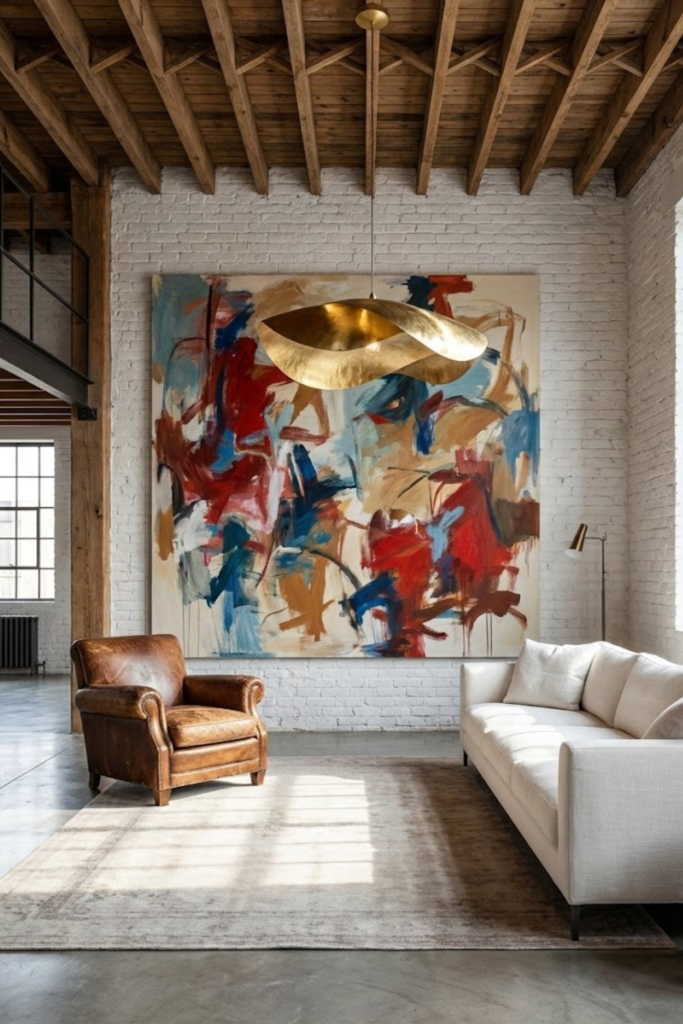
I have always admired those cool artist lofts you see in movies—the ones with high ceilings and big paintings everywhere. But the problem is, they often look like museums. You feel like you can’t sit down or touch anything. I wanted that artistic vibe in my own living room, but I also wanted to be able to take a nap on the couch. That is how the “Gallery-Soft Loft” style was born. It mixes the clean, white look of an art gallery with the soft, squishy comfort of a real home.
The White Wall Trick
To pull this off, you need to think of your walls as a blank sheet of paper. I painted my living room a crisp, bright white. I know, people say white is boring, but in this case, it is doing a job. It makes everything you put in front of it pop.
Once the walls were white, I hung up one huge piece of abstract art. And I mean huge. It takes up almost half the wall. It instantly makes the room feel grander and more important. You don’t need to spend a million bucks on art, either. I made my own using a big canvas and some leftover paint, and my friends always ask where I bought it. It gives the room a focal point so you don’t have to worry about decorating every little corner.
Lighting is the Jewelry
In this style, lights aren’t just for seeing in the dark. They are like jewelry for the room. I ditched my boring ceiling fan for a sculptural gold pendant light. It looks like a piece of modern art hanging from the ceiling.
When you choose a light fixture, look for something with an interesting shape. Maybe it has weird angles or curves. Even when it is turned off, it should look cool. It adds that “loft” feeling without you having to knock down walls or expose brick. It is a small change that makes a big statement.
Don’t Match Everything
Here is a secret: matching furniture sets make a room look flat. The Gallery-Soft look relies on mixing things up. I have a sleek, modern white sofa, but right next to it, I put an old, beat-up leather armchair I found at a flea market.
The mix of the new, clean sofa and the old, worn-in chair creates a story. It makes the room feel “collected” over time, not just bought from a catalog in one day. It stops the room from feeling sterile. You want pieces that look like they have a history.
Organized Curiosities
We all have little things we love—books, travel souvenirs, odd little statues. In a normal room, these can look like clutter. But in a gallery style, you treat them like exhibits. I use floating shelves (the kind where you can’t see the brackets) to display my favorite things.
But here is the rule: give them space. Don’t jam 20 books onto one shelf. Put three books and maybe one nice rock or a small vase. Leaving empty space around objects makes them look special. It keeps the simple, clean vibe while still showing off your personality. It is about being organized, not getting rid of everything you own.
Conclusion
Well, we made it to the end. Looking back at these 7 simple living room designs, it is funny how much things have changed just in the last few years. We used to think simple meant “empty,” but I think 2026 has finally taught us that simple actually just means “intentional.” It is about picking the stuff that actually makes you happy and comfortable, and getting rid of the rest.
I know changing up a room can feel like a huge job. I’ve been there, staring at a room full of old furniture and wondering where to even start. But you don’t have to do it all at once. Maybe you just paint one wall that warm terracotta color, or you swap out a stiff chair for something with curves. Small steps count.
The most important thing I tell my friends is that your home should look like you. It doesn’t matter if the magazines say grey is out; if you love it, keep it. But if you are looking for a fresh start, these trends are a great way to make your space feel new again without losing that cozy feeling. I really hope you found something here that sparked an idea for your own place.
If you found these ideas helpful, please pin this article to your “Home Decor 2026” board on Pinterest. It helps others find these tips and saves them for when you are ready to start your project!