Did you know that we spend approximately one-third of our lives in bed? It’s true! Yet, so many of us treat our bedrooms as an afterthought—a place to simply crash when the day is done. But here is the thing: your bedroom should be your ultimate sanctuary, a space that wraps you in a hug the moment you cross the threshold.
In 2026, the trends are shifting away from stark, showroom perfection toward spaces that feel deeply personal, tactile, and restorative. We are talking about designs that prioritize feeling good over just looking good. Whether you are craving the grounding calm of nature or the dramatic embrace of moody hues, updating your sleep space can genuinely improve your quality of life. I’ve gathered the freshest, most stylish ideas to help you reclaim your rest. Let’s dive into the designs that are redefining comfort this year!
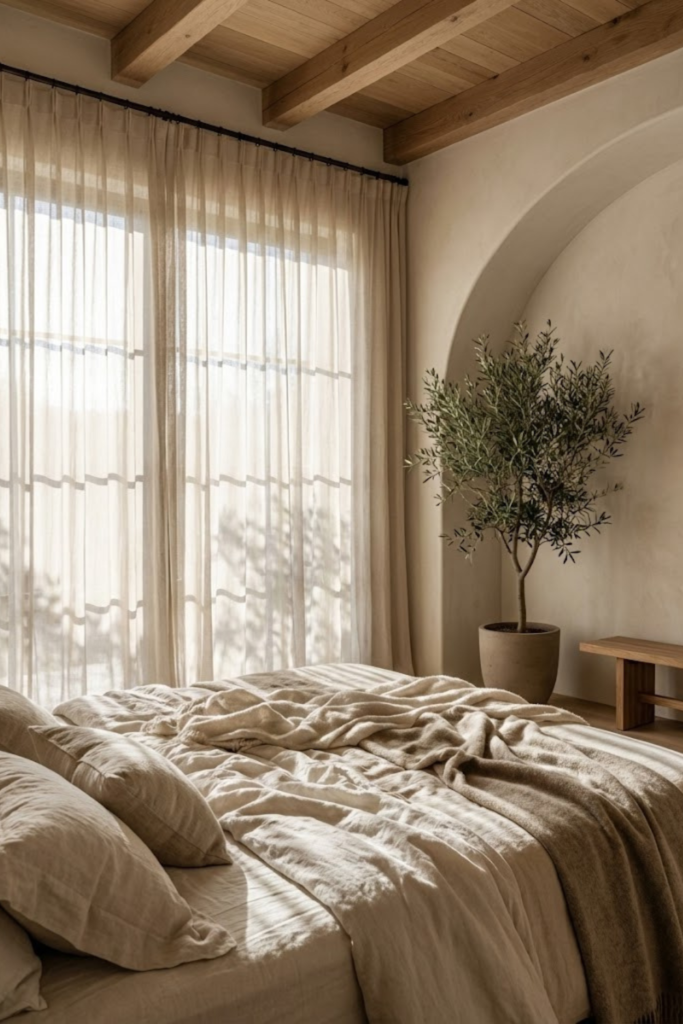
1. Embrace Biophilic Design for a Calming Retreat

Honestly, if there is one change I made that actually fixed my sleep schedule, it was bringing a bit of the outdoors inside. We spend so much time looking at screens and sitting in concrete boxes that our brains just kind of forget how to relax. That is where biophilic design comes in. It sounds like a fancy science word, but it really just means connecting your room back to nature.
I remember when I first tried this. I didn’t want my room to look like a jungle or a greenhouse. The trick is balance. You want your bedroom to feel like a deep breath of fresh air the second you walk in. It’s about creating a space that lowers your heart rate without you even trying.
More Than Just Potted Plants
A lot of people think this style is just about buying a fern and calling it a day. But it goes deeper than that. Think about the materials you are using. I swapped out a shiny metal nightstand for a raw wood stump table I found at a flea market, and the difference was crazy.
Try to bring in things like bamboo, stone, or unpolished wood. These textures warm up the room and make it feel grounded. If you can, open those curtains wide during the day. Natural light is a huge part of this. It tells your body when to be awake and when to wind down.
Picking the Right Greenery
Now, about the plants. I used to kill every plant I touched, so I get it if you are nervous. You don’t need to be an expert gardener. Start with a Snake Plant or a Pothos. They are pretty much unkillable and they look great.
Plus, there is a bonus. Plants like Peace Lilies actually clean the air. I noticed the air in my room felt less stale after I added a couple of big leafy friends in the corners. It’s nice knowing your decor is working for you while you sleep.
Colors from the Earth
Finally, look at your walls and bedding. If you are going for this look, stay away from harsh neon colors. Think about the colors you see on a hike. Sage green, warm clay, sandy beige, and soft browns are perfect. These earthy tones wrap you up and make the space feel safe and cozy. It really helps you disconnect from the stress of the day and just drift off.
2. The New Neutrals: Warm Minimalism

I used to think minimalism meant having zero stuff and white walls that looked like a hospital. I tried that once a few years ago. It felt cold, and honestly, it was impossible to keep clean with a dog and kids running around. It just didn’t feel like a home. But the “Warm Minimalism” we are seeing in 2026 is completely different, and I think it is exactly what a lot of us need right now.
It is still about keeping things clean and uncluttered, but it ditches that stark, chilly vibe for something that feels like a warm hug. It’s about creating a space where you can actually relax without worrying about messing up a perfect magazine cover.
Not Your Doctor’s Office
The biggest change here is the color palette. We are moving away from that bright, blinding white. Instead, think about colors like oatmeal, sandy beige, soft clay, or a creamy taupe. I painted my guest room a color called “cashmere” recently, and the difference is night and day.
These colors reflect light in a softer way. They make the room feel sunny even on a cloudy day. The goal is to create a backdrop that feels calm and settling. When you walk in, your eyes shouldn’t be bouncing around the room; they should just rest. It creates a blank canvas, but one that has a little bit of soul to it.
Texture is the Secret Sauce
Here is the trick I tell everyone: when you remove bright colors, you have to add texture. If you don’t, the room will look flat and boring. You need to give your eyes something to look at and your hands something to touch.
In a warm minimalist bedroom, you want to mix materials. I love pairing a smooth wooden headboard with a nubby, bouclé armchair. Throw a chunky wool blanket on top of smooth cotton sheets. It’s that mix of rough and soft that makes the room feel expensive and finished. You aren’t relying on a bright red pillow to make a statement; you are letting the materials do the talking.
Lighting Makes or Breaks It
You can pick the perfect paint and the best furniture, but bad lighting will ruin it instantly. For this style, stay far away from those “daylight” or cool-toned light bulbs. They turn everything blue and clinical.
You want warm white bulbs—look for 2700K on the box when you are at the store. I also recommend having a few different light sources. Don’t just use the big light on the ceiling. Get a couple of ceramic lamps for your nightstands or a floor lamp for the corner. Using lamps creates pools of light that make the beige and wood tones glow. It builds that cozy atmosphere that makes it hard to get out of bed in the morning!
3. Make a Statement with Canopy Beds

I have to admit, I was skeptical about this one at first. When I used to think of canopy beds, I pictured those heavy, dusty curtains in a museum or something out of a fairy tale movie. But let me tell you, the modern versions are nothing like that. I recently helped my sister redo her master bedroom, and she insisted on a four-poster frame. Once we got it set up, I totally understood the hype. It instantly made the room feel “finished” in a way a normal headboard just can’t do.
In 2026, we are seeing these beds everywhere. They act like a room within a room. If you have a big bedroom, sometimes the furniture can look small and lost. A canopy bed fixes that problem right away. It draws your eye up and fills the vertical space, making everything look balanced.
Keep It Breezy and Light
The key to making this work today is not to go overboard with the fabric. You usually don’t need heavy velvet drapes that block out the sun (unless you really want that dark, moody vibe). Most people I talk to are using light, sheer fabrics.
I helped hang some white gauzy linen drapes on a black metal frame recently, and it looked so airy. It gives you that feeling of privacy and coziness without making the room feel closed off. It’s romantic without trying too hard. Plus, practically speaking, lighter fabrics are way easier to take down and wash. As someone who hates dusting, that is a big win in my book.
It Fits More Styles Than You Think
You might think this only works in a big, fancy house with high ceilings, but that is not true. I’ve seen simple wooden canopy frames in smaller apartments that look amazing. It actually helps define the sleeping area, almost like drawing a border around your rest zone.
If you like that “cottage core” look that is still popular, a raw wooden frame is perfect. It feels rustic and warm. If you want something more modern or industrial, go for a thin black metal frame. It adds a sharp, clean line to the room.
The Psychological Comfort
There is something primitive about wanting to feel enclosed when we sleep. It goes back to feeling safe. Even if you don’t hang curtains on it, just having the rails above you creates a sense of shelter. It signals to your brain that this space is protected and specifically for rest.
You also don’t need to put a ton of art on the walls because the bed itself is the art. It takes the pressure off decorating every other corner of the room. Just a quick tip: make sure you measure your ceiling height before you buy one. You want at least a foot of clearance ideally. I learned that the hard way once, and sawing legs off a metal bed is not a fun Saturday afternoon project!
4. Moody Color Drenching for Cozy Vibes
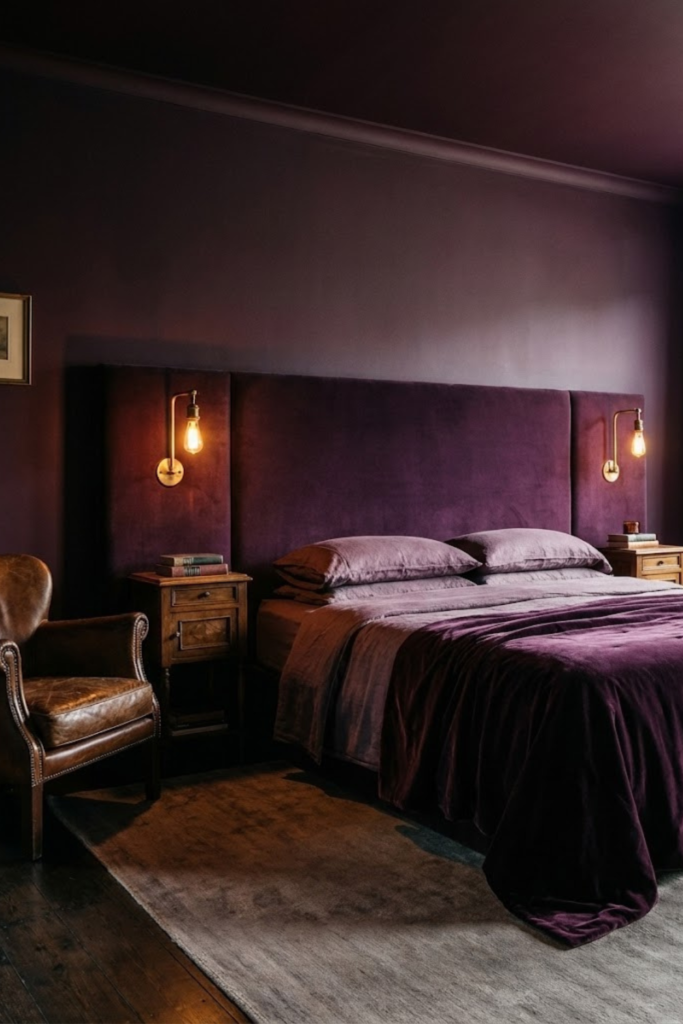
I used to be terrified of dark paint. I grew up thinking that if a room wasn’t white or light yellow, it would feel like a dungeon. But recently, I took a risk and painted my entire bedroom a deep, moody navy blue, and it completely changed my mind. This trend is called “color drenching,” and it is huge right now for a reason.
Instead of just painting the walls and leaving the trim white, you paint everything the same color. I mean everything—the baseboards, the door frames, the window sills, and yes, even the ceiling. It sounds intense, I know. But the result isn’t scary; it is incredibly calming. It turns your room into a seamless cocoon that wraps around you.
Why Darker is Actually Better
We often think we need light colors to make a room feel open, but in a bedroom, do you really want it to feel like a bright cafeteria? Probably not. You want to sleep! Darker colors absorb light instead of bouncing it around.
When I switch off the lights in my color-drenched room, it gets properly dark. It signals to my brain immediately that the day is over. It feels quieter, somehow. Colors like deep forest green, midnight blue, or even a rich aubergine (eggplant purple) are very popular this year. They have a way of calming down your nervous system that bright white just can’t match.
The Ceiling Trick
Here is the mistake I see people make all the time: they get brave enough to paint the walls dark, but they chicken out on the ceiling and leave it white. Please don’t do that!
If you leave the ceiling white, it creates a harsh line that draws your eye up and makes the ceiling feel lower, like a lid on a box. When you paint the ceiling the same dark color as the walls, the corners of the room disappear. You can’t really tell where the walls end and the ceiling begins. It actually makes the room feel bigger and taller, like you are staring up into the night sky.
Adding a Little Sparkle
Now, you don’t want the room to look like a black hole. Since the walls are dark, you need to add some contrast with your decor. This is the perfect time to use metallic accents.
I bought a brass floor lamp and swapped out my drawer handles for gold ones. Against the dark paint, that metal pops. It looks so elegant, almost like jewelry for your room. You can also use lighter bedding—creamy white sheets or a light gray duvet—to break up the color. It creates a balance so the room feels moody and sophisticated, not gloomy.
5. Layer Tactile Textures for Depth
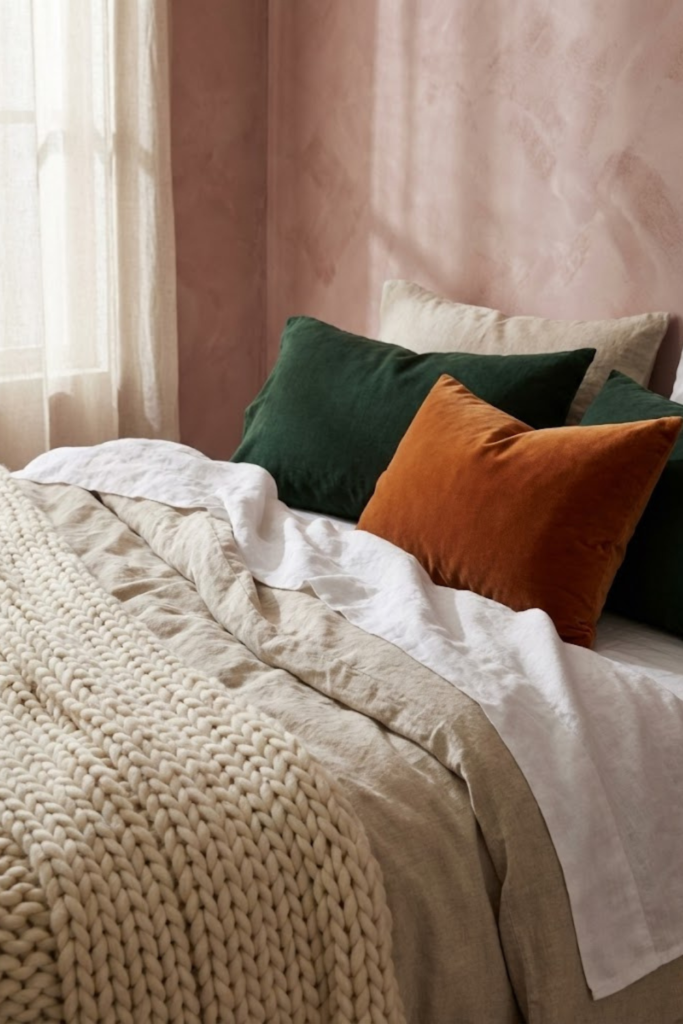
Have you ever walked into a room that looked perfect in a photo, but when you actually stood in it, it felt… kind of flat? I used to have that problem all the time. I would buy everything from the same store, everything matching perfectly, and then wonder why my bedroom felt like a showroom instead of a home. It took me a while to figure out that I was missing the most important part: texture.
It is not just about what you see; it is about what you feel. We are tactile creatures. When we are tired, we want soft, cozy things touching our skin. If every surface in your room is smooth and shiny, your brain doesn’t get those comforting signals. Layering textures is the secret to making a room feel “expensive” and finished without spending a fortune.
The “Touch Test”
Here is a simple rule I use now. I call it the “touch test.” If I close my eyes and run my hand across the bed, the chair, and the rug, do they all feel the same? If they do, I need to switch things up.
You want a mix. Think about pairing a rough wooden nightstand with a smooth ceramic lamp. Or a metal bed frame with a super soft velvet pillow. It is that contrast that makes the room interesting. Your eyes need that variety to keep looking around. If everything is the same, your eyes get bored, and the room feels stale.
Bedding is the Easiest Fix
The bed is obviously the biggest thing in the room, so start there. I used to be a “crisp white cotton sheets” only kind of guy. But now, I love linen. It has this natural, slightly wrinkled texture that just looks so inviting. It says, “It’s okay to relax here.”
Don’t stop at the sheets, though. Throw a chunky knit wool blanket at the end of the bed. It adds visual weight and warmth. Then, add a couple of pillows in a different fabric, maybe something fuzzy or velvet. Suddenly, your bed looks like a cloud you want to dive into, not just a flat surface.
Walls and Floors Need Love Too
We often forget about the walls and floor. If you have hardwood floors, they are beautiful, but they can feel cold on bare feet in the morning. I always put a high-pile rug or even a real sheepskin right where my feet hit the floor. It is such a nice way to wake up.
For walls, you don’t always need art. I tried “limewash” paint last year, and it adds this subtle, cloudy texture to the wall itself. It catches the light differently than flat paint. It makes the walls feel like they have history and depth. It’s a bit more work to apply, but the cozy feeling it gives the room is totally worth it.
6.Heritage Nostalgia and Vintage Charm

You know that feeling when you walk into an old house, maybe your grandmother’s place, and it just feels… settled? Like the house has stories to tell? That is the vibe we are chasing with this idea. For the longest time, I thought “modern” meant throwing out anything old and buying a matching bedroom set from a catalog. I did that once. My room looked nice, but it felt like a hotel. It had no soul.
In 2026, we are seeing a huge return to what people are calling “Heritage Nostalgia.” It sounds fancy, but it just means mixing old stuff with new stuff to make a room that feels lived-in and comfortable. It is about creating a space that feels like it has been there forever, even if you just decorated it last week.
Breaking Up the Set
The first rule here is to stop buying the matching set. If your bed frame, dresser, and nightstands all match perfectly, the room can look a bit stiff. I decided to keep my modern bed but swapped out the nightstands for two mismatched antique tables I found at a local thrift store.
One was a bit scratched, but that was the point. Those imperfections add character. It makes the room feel less precious. You don’t have to worry about putting a glass of water down because the table has already seen fifty years of life. It takes the pressure off. If you are new to this, start small. Look for a vintage wooden chair to put in the corner or an old trunk to put at the end of the bed for storage.
Patterns that Feel Like Home
Another big part of this look is bringing back patterns we used to think were “dated.” I am talking about floral wallpapers, plaid wool blankets, and those beautiful, intricate Persian-style rugs.
I was nervous to try wallpaper, so I just did one wall behind my bed. I picked a soft floral pattern that looked like something from an old storybook. It instantly made the room feel warmer. If you don’t want to paint or paper, just get a vintage rug. A faded red or blue rug can anchor the whole room. It adds color without being too loud. It brings a sense of history that a plain gray carpet just can’t give you.
Good for the Planet, Good for You
There is a practical side to this too. Buying vintage is the greenest way to shop. Instead of buying cheap furniture that might break in a few years, you are saving something that was built to last.
I have a dresser that is solid wood, heavy as a rock. I paid half the price of a new particle-board one. It feels good knowing I’m not adding to a landfill. Plus, hunting for these pieces is actually fun. It becomes a hobby. You aren’t just clicking “add to cart”; you are finding treasures. And when you look around your room, every piece has a story about where you found it.
7. Create a Wellness & Tech-Free Sanctuary

I love my phone as much as anyone. Probably too much. But bringing it into the bedroom was the worst habit I ever started. I would tell myself I was just going to check the news for five minutes, and suddenly it was midnight. My brain was buzzing, and I couldn’t shut it off.
In 2026, we are seeing a huge push to turn bedrooms back into what they are supposed to be: places for rest, not scrolling. It is about creating a “wellness sanctuary.” That might sound like marketing speak, but it really just means designing a room that helps your body wind down instead of keeping it awake.
The Hardest Step: The Digital Detox
The first thing I did—and I know this hurts to hear—was moving my charger. I put it in the kitchen. If my phone is next to my bed, I will look at it. It is just a fact. I swapped it out for an old-school alarm clock.
Getting the TV out of the room was the next step. I used to fall asleep with the TV on, but the blue light from screens actually messes with your melatonin. That is the chemical that tells your body it is time to sleep. Once I removed the screens, the room felt quieter. It stopped feeling like an extension of my office or living room. It became a dedicated space just for recharging my own batteries, not my phone’s.
Waking Up Naturally
Since I couldn’t use my phone as an alarm anymore, I looked into “smart lighting.” This has been a game-changer for my mornings. I installed bulbs that are connected to a timer.
Instead of a loud, jarring beeping noise that scares you half to death at 6 AM, my lights slowly start to turn on thirty minutes before I need to get up. They start a soft red-orange and fade into a bright yellow, just like a sunrise. It wakes your body up gently. I am not a morning person at all, but this made getting out of bed way less painful. You feel ready to go, rather than groggy.
A Spot for Quiet
Another big part of a wellness bedroom is having a “zone” that isn’t the bed. If you do everything in bed—read, work on your laptop, watch movies—your brain gets confused. It stops associating the mattress with sleep.
I cleared out a messy corner and put a comfortable armchair and a small side table there. That is my reading nook. I try to sit there for ten minutes before I actually get under the covers. Maybe I read a few pages of a book or just sit and breathe. It acts like a buffer zone. It tells my mind, “Okay, the day is done. Time to transition to sleep mode.” It helps separate the stress of the day from the peace of the night.
Conclusion
So, there you have it. We have talked about everything from painting your ceiling purple to throwing out your TV. I know it can feel like a lot. When I first started trying to fix up my house, I felt like I had to do everything at once. I didn’t. And you don’t have to either.
Your bedroom is the most personal room in your house. It is where you start and end your day. It shouldn’t stress you out. Whether you decide to hunt for a vintage rug or just buy a couple of plants, the goal is the same: create a space that makes you happy.
Don’t worry about what the magazines say is “perfect.” Focus on how the room makes you feel. If you love it, then it is perfect. Now, go get started. Even moving one chair can make a difference.
Found this article helpful? Save this pin to your “Bedroom Ideas” board on Pinterest!