I used to live in an apartment where my bed touched three walls. I’m not kidding! It felt like sleeping in a cupboard. But that tiny shoe-box taught me a valuable lesson: limitation is the mother of invention. If you are staring at your small bedroom and feeling claustrophobic, take a deep breath. We are about to change how you see that space.
According to recent design reports, 2026 is the year of “cocooning”—embracing small spaces rather than fighting them. We aren’t just trying to fake space anymore; we are creating rooms that feel like a warm hug. In this guide, I’m sharing the tricks I’ve learned the hard way. We’ll look at everything from lighting hacks that save table space to the paint trend that blurs the edges of your room. Ready to ditch the clutter? Let’s dive in.
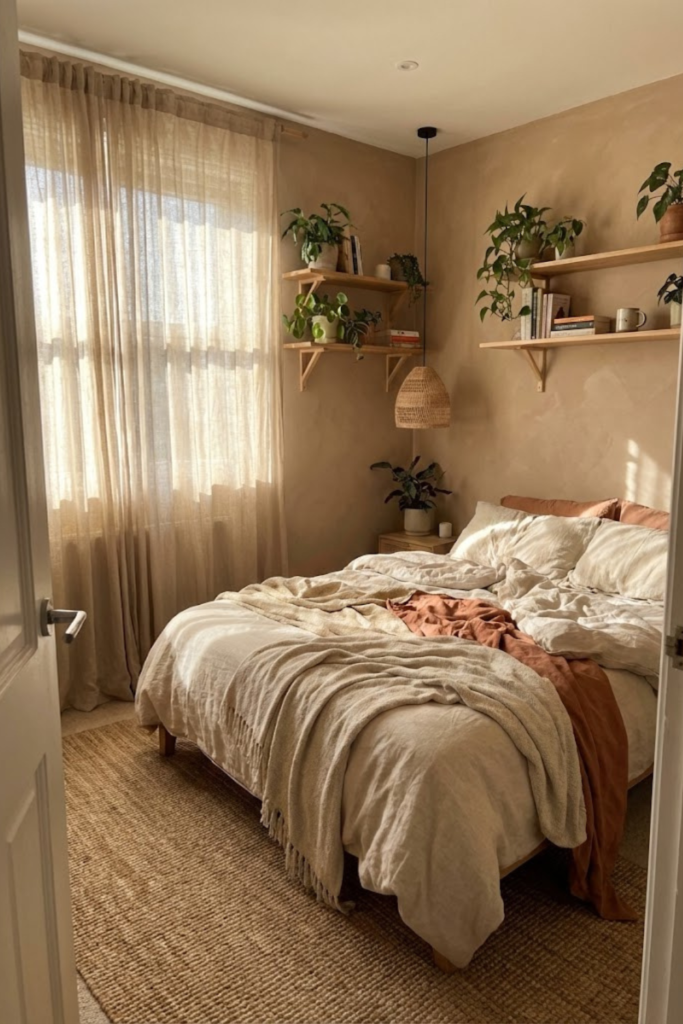
1. Master the Art of Color Drenching
I remember when I got the keys to my very first apartment. The bedroom was tiny—barely enough room to walk around the bed. I did what everyone told me to do: I painted the walls bright white. I thought, “White reflects light, so it will make the room look massive, right?”
Wrong. It didn’t look big; it looked like a doctor’s waiting room. It felt cold, and because the walls were white and the floor was dark, my eye went straight to the corners. It basically highlighted the exact dimensions of the box I was living in. That is when I learned about color drenching. It sounds like a fancy designer term, but it is actually the easiest way to paint a room because you don’t have to worry about cutting in perfect lines.
What Exactly Is It?
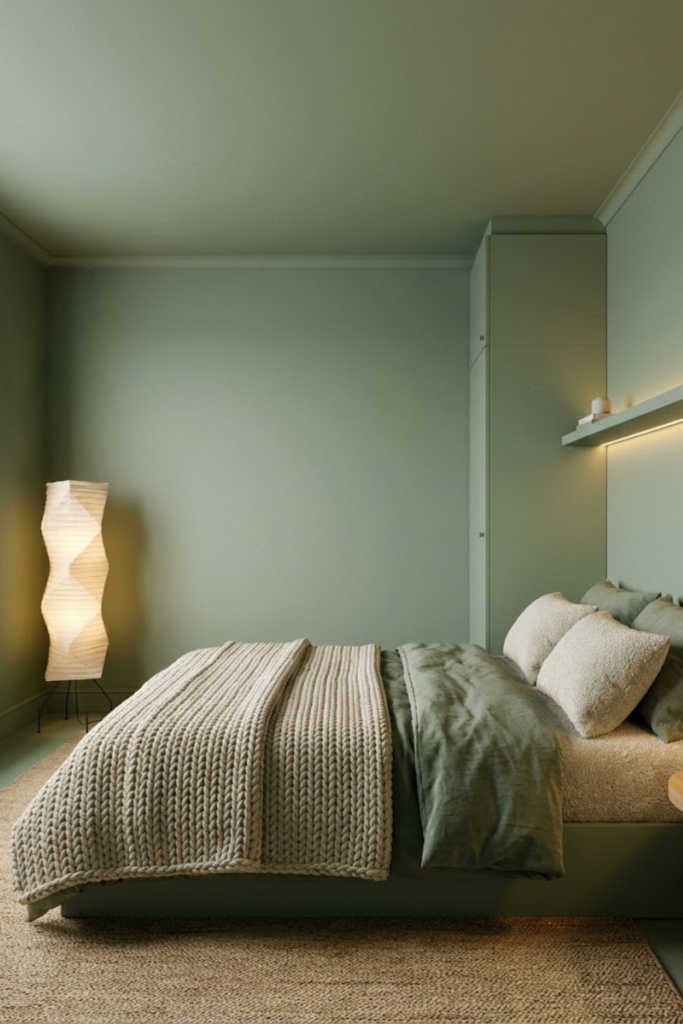
Basically, color drenching means you stop treating your surfaces as different zones. Usually, we paint the walls one color, the ceiling white, and the trim semi-gloss white. With this technique, you pick one color—maybe a calm sage green or a warm beige—and you paint everything. I mean everything. The baseboards, the window frames, the door, the walls, and yes, even the ceiling.
Why It Tricks the Eye
Here is why this works for small spaces. When you have a white ceiling and colored walls, your eye immediately notices the line where the wall stops and the ceiling starts. That line tells your brain, “Okay, the room ends right here.” It defines the height of the room, which usually makes it feel shorter.
When you drench the room in one color, those hard lines get blurry. Your eye doesn’t get stuck on the corners or the ceiling line because there is no contrast to stop it. It just keeps moving. It creates a seamless look that feels sort of infinite, like being inside a cozy cloud rather than a box. I tried this in my guest room last year, and my friends swear the ceilings look two feet higher than they actually are.
Don’t Fear the Dark
A lot of people think small rooms need light colors. That isn’t always true. Dark colors like navy or charcoal can be amazing in small bedrooms. Dark colors “recede,” which is a fancy way of saying they look further away from you visually. This adds depth. It creates a cozy, cave-like feeling that is perfect for sleeping.
Handling the “Ugly” Stuff
To make this really work, you have to commit. One mistake I see is people leaving the radiator or the light switch covers white. Don’t do that! It breaks the spell. If you have an ugly radiator, get some metal paint mixed in the same color as your walls and paint it. Make it disappear. The goal is to remove visual clutter so your eye can relax. It’s a simple weekend project, but the payoff is huge.
2. Go Vertical or Go Home
When I first moved into a studio flat years ago, I had a bit of a meltdown. I had too much stuff and zero floor space. I remember staring at the floor plan and feeling totally stuck. But then a friend told me, “Youssef, you are paying for the whole volume of the room, not just the carpet.” That clicked for me. I stopped looking down at my feet and started looking up at the walls.
We often get obsessed with the “footprint” of our furniture, but in a small bedroom, the walls are your best friend. If you can’t build out, you have to build up. It is the only way to fit your life into a 10×10 space without tripping over things.
The Curtain Trick
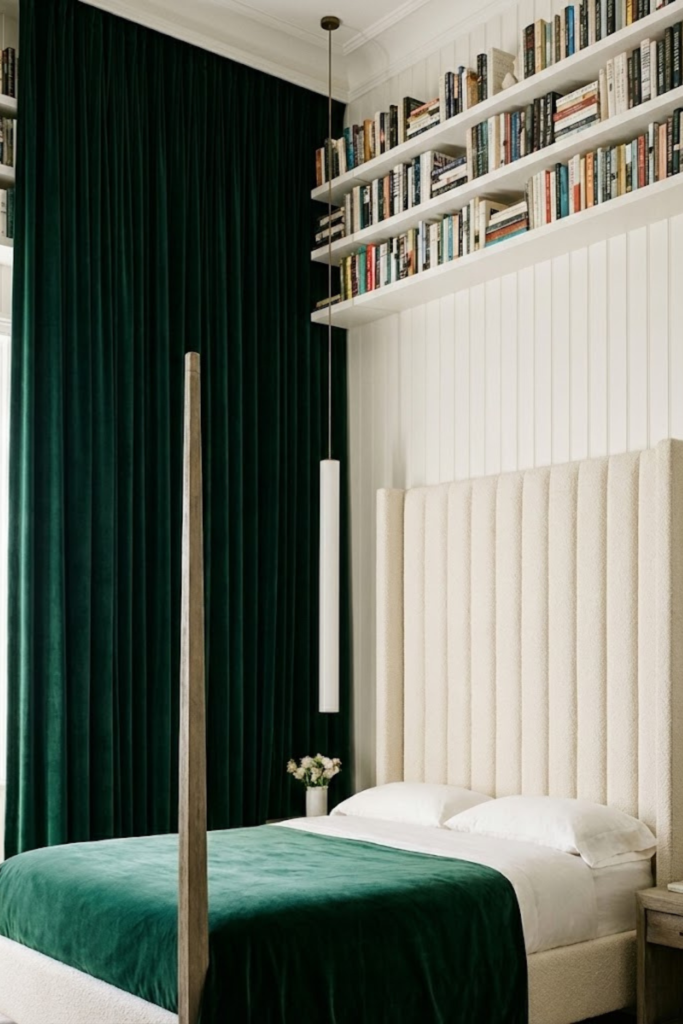
This is my favorite trick because it is so cheap to do. Most people hang their curtain rod right above the window frame. Please, don’t do that. It cuts the wall in half and makes the ceiling feel lower. I learned to hang the rod as high as possible—literally two inches from the ceiling line—even if the window is small.
Then, make sure the curtains go all the way to the floor. This draws your eye all the way up, creating a long vertical line. It is like wearing vertical stripes; it just makes the room look taller. Also, extend the rod wider than the window itself. When the curtains are open, they should sit against the wall, not covering the glass. This tricks your brain into thinking the window is huge.
Use the “Dead Zone”
Look above your bedroom door right now. What is there? Probably nothing. Just a blank wall gathering dust. That is prime real estate! In my last place, I installed a simple white shelf right above the door frame. It is a space you never walk through, so you won’t bump your head.
I put three matching baskets up there to hold my winter scarves and hats. It didn’t take up any walking space, but it gave me a whole new “closet” out of thin air. You can do the same with books or old yearbooks you don’t need every day. It turns a weird, empty spot into something useful.
Go Tall and Skinny
If you are shopping for furniture, ignore the short, wide dressers. They eat up too much floor. You want tall, skinny chests of drawers. I swapped my wide dresser for a tall boy style chest, and suddenly I had room to actually walk to the window.
The same goes for bookcases. Try to get shelving that goes all the way to the ceiling. If you leave a gap between the top of your bookshelf and the ceiling, it usually just becomes a dark shadow that collects dust bunnies. Bringing furniture to the ceiling makes the room look grander and gives you maximum storage for every inch of floor space you use.
3. The “No-Nightstand” Lighting Hack
I have a confession to make. For years, my bedside table was a disaster zone. It was a small, wobbly table, and I had a giant lamp sitting right in the middle of it. If I wanted to put down a book or a glass of water, I had to play a game of Tetris. I can’t tell you how many times I knocked my glasses off the edge while trying to turn off the light in the dark. It was frustrating.
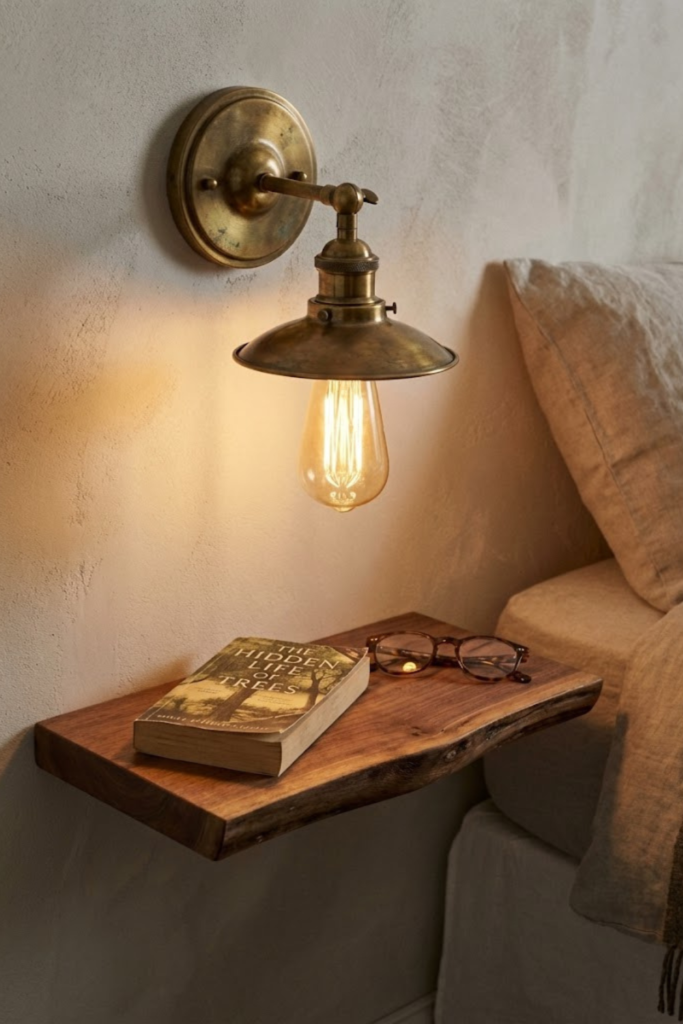
In a small bedroom, the surface area next to your bed is like gold dust. You don’t want to waste 70% of it on a lamp base. That is why getting your lighting off the table and onto the wall or ceiling is one of the smartest moves you can make. It instantly makes the room feel less cluttered and more “designed.”
The Magic of Sconces
Wall sconces are my favorite fix for this. A sconce is just a light fixture attached to the wall. By mounting lights on either side of the bed, you clear off the entire nightstand. Suddenly, you have room for your phone, your current read, and a cup of tea without fear of spilling anything.
Now, I know what you might be thinking. “Youssef, I rent my apartment. I can’t start drilling holes and messing with electrical wires.” I hear you. I’ve been there. The good news is that you don’t need to call an electrician. They make “plug-in” sconces now. You just screw the bracket into the wall, hang the light, and plug the cord into the outlet below. Some of them even have cool cords that add to the look. It takes about ten minutes to put up, and it changes the whole vibe of the sleeping area.
Pendants Aren’t Just for Kitchens
If you don’t have wall space because of a window or a weird corner, look up. Hanging a pendant light from the ceiling right above your nightstand is another great trick. It draws the eye upward (remember our vertical rule?), and it keeps the table completely clear. It looks very modern and a bit hotel-like.
Just be careful with the height. You want the bottom of the light to hang low enough that you aren’t staring into a bright bulb while lying in bed, but high enough that you don’t smack your head when you sit up. I usually aim for it to hang about 20 inches above the mattress height.
Ditch the “Big Light”
Finally, let’s talk about atmosphere. In a small room, overhead lighting can be harsh. It casts shadows in the corners and makes the room feel smaller and colder. I almost never turn on my main ceiling light. By using sconces or pendants with warm bulbs, you create pools of soft light. This blurs the edges of the room and makes it feel cozy rather than cramped. It turns your small bedroom into a little sanctuary where you actually want to hang out.
4. The Magic of Mirrors
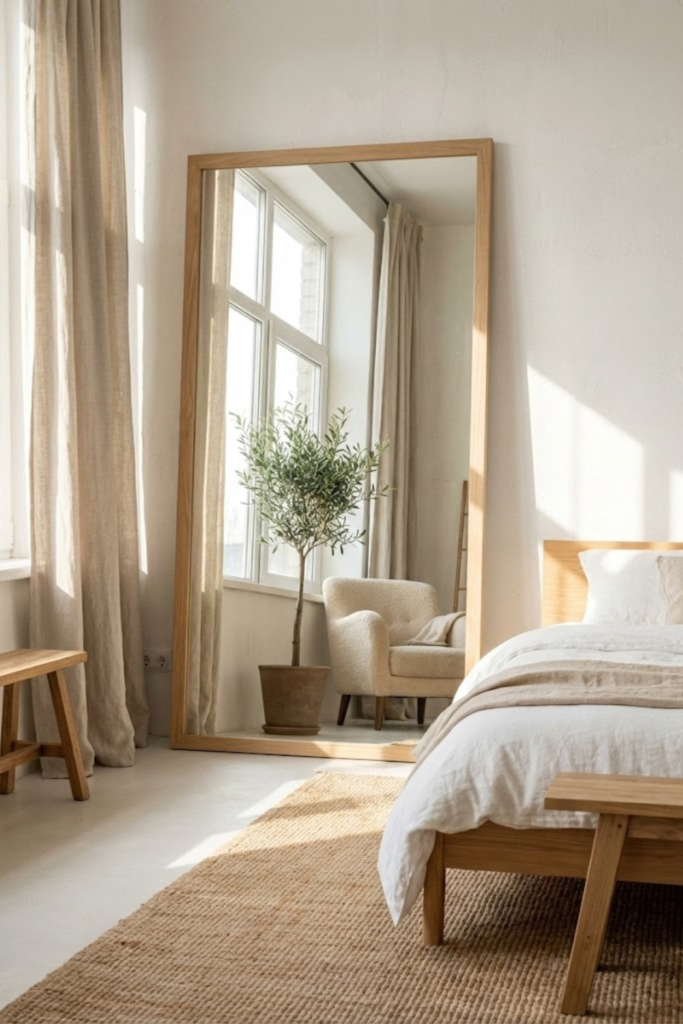
I used to live in a ground-floor flat that got almost zero sunlight. It was a bit gloomy, to be honest. I felt like I was living in a cave. One Saturday, I found a giant, beat-up mirror at a garage sale for twenty bucks. I dragged it home, cleaned it up, and leaned it against the wall. The change was instant. It didn’t just let me check my hair; it felt like I had knocked a hole in the wall and added a whole new room.
Designers talk about mirrors all the time, but I think people underestimate them. In a small bedroom, a mirror isn’t just a decoration. It is a tool. It is the only thing you can buy that doubles your space visually without you actually knocking down a wall.
Position is Key
You can’t just hang a mirror anywhere and expect magic. You have to be strategic. The best spot for a mirror is directly across from a window. Why? Because it catches the natural light coming in and bounces it right back into the room. It acts like a second window.
If your room is dark, this is a game-changer. Suddenly, that one beam of morning sun is hitting two walls instead of one. If you can’t put it opposite a window, try placing it behind a light source, like a lamp. It will amplify the glow and make the room feel brighter and happier.
Make Furniture Disappear
Let’s be real: wardrobes are huge. In a small bedroom, a big wooden wardrobe can feel like a moody elephant standing in the corner. It sucks up all the light and makes the room feel heavy. My solution? Mirrored doors.
If you have a wardrobe with mirrored doors, the heavy piece of furniture basically disappears. It reflects the floor and the bed, so your eye doesn’t stop at the wardrobe door. It tricks your brain into thinking the floor space continues. If you are renting and have a plain wardrobe, you can even buy stick-on mirror tiles or a hanging mirror to mount on the door. It’s a cheap fix that makes a massive difference.
The Leaning Look
If you have a blank wall but are afraid to drill holes (or your landlord won’t let you), try an oversized floor mirror. You just lean it against the wall. It looks very relaxed and cool, like an artist’s studio.
Because a floor mirror is tall, it draws the eye up, helping with that vertical height we talked about earlier. Plus, it adds a sense of depth. When you look into a large mirror, it looks like there is a hallway or another room beyond the glass. It stops you from feeling like you are staring at a dead end. Just make sure to secure it if you have pets or kids—safety first!
5. Unlock Under-Bed Real Estate
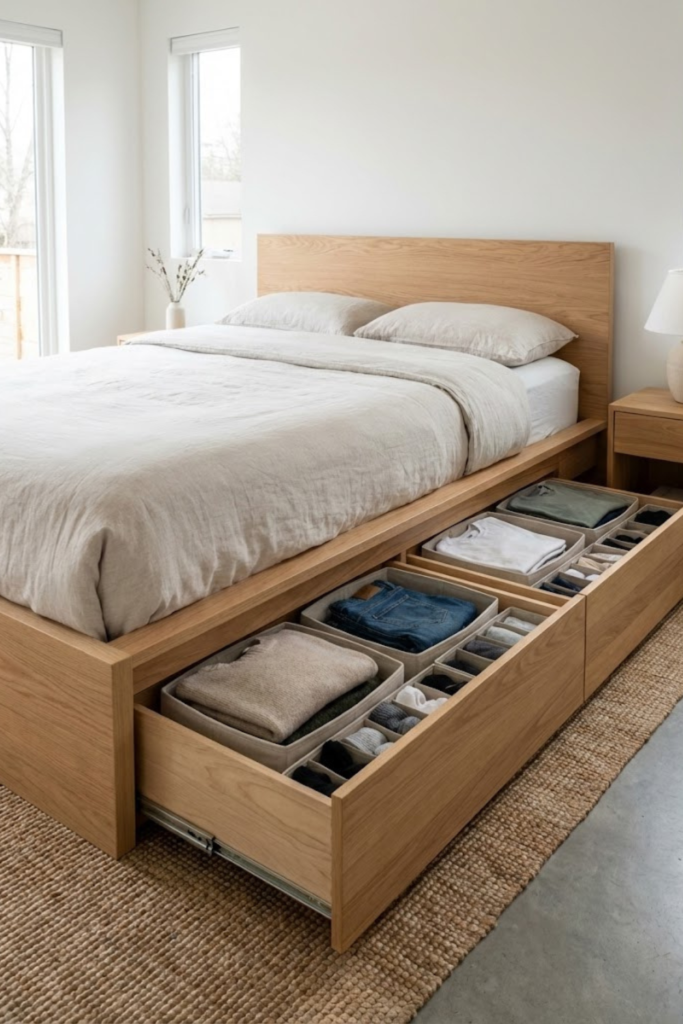
I used to treat the space under my bed like a black hole. If I didn’t know where to put something—an old textbook, a winter coat, a box of photos—I would just shove it under the mattress and forget about it. It was a mess. But then I did the math. A queen-sized bed takes up about 30 square feet of space. In a small bedroom, that is huge! If you aren’t using that space properly, you are basically throwing away a whole closet.
When you have a tiny room, you can’t afford to have “dead space.” The area under your bed is the secret weapon for keeping the rest of your room looking clean and open. If you hide the clutter down there, your shelves and floor stay clear.
The Ottoman Bed Revolution
If you are in the market for a new bed, I am going to give you the best advice I have: buy an ottoman bed. This is the kind where the mattress lifts up on hydraulics, revealing the entire base as storage. It is honestly life-changing.
I bought one a few years ago. It opens up like a car trunk. Inside, I keep my suitcase, my spare duvet, and all my winter sweaters during the summer. It holds as much as a chest of drawers, but it takes up zero extra floor space. It keeps the dust off your stuff, too. It costs a bit more than a regular frame, but for a small room, it is worth every penny.
Working With What You Have
If you can’t buy a new bed, don’t worry. You can still fix this. The key is to get storage containers that roll. Trying to drag a heavy cardboard box out from under a bed scratches the floor and is a pain in the back.
Go to the store and get long, flat plastic bins with wheels. They are cheap. I use them for shoes. You know those shoes you only wear for weddings or fancy dinners? Put them in a bin under the bed. Suddenly, the shoe rack by the door isn’t overflowing anymore. If your bed frame is open and you can see underneath, use wicker baskets or fabric bins so it looks like a design choice, not just storage.
The Bed Riser Trick
Sometimes, the bed is just too low to fit anything good underneath. I had this problem in college. The solution is “bed risers.” They are these sturdy little plastic or wood feet that you put under the legs of your bed frame.
They lift the bed up by about 3 to 5 inches. It doesn’t sound like much, but that extra height is the difference between fitting a thick storage bin or fitting nothing. You can hide the risers with a long bed skirt if you think they look ugly. It’s a five-dollar fix that gives you cubic feet of new storage. Just make sure you don’t store things you need every single day down there, or you will get annoyed crawling on the floor every morning. Keep it for the seasonal stuff.
6. Multi-Functional Zones
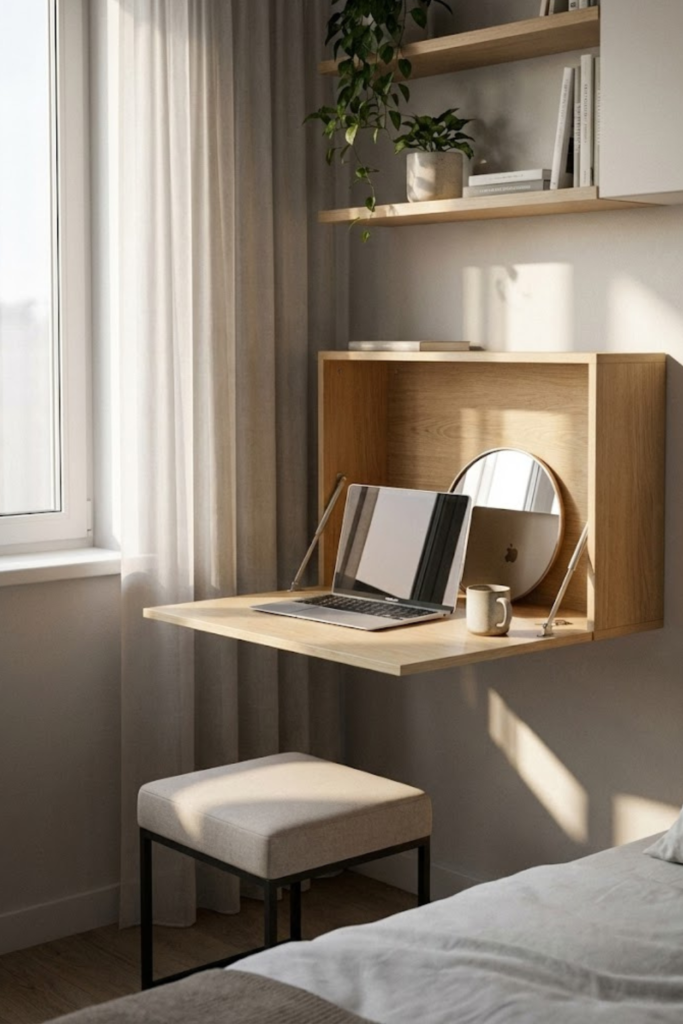
I used to think a bedroom was just for sleeping. But let’s be honest, in a small home or apartment, the bedroom often has to be the office, the dressing room, and the reading nook all at once. When I first started working from home occasionally, I tried to shove a regular office desk into the corner of my 10×12 bedroom. It was a disaster. I felt like I was sleeping in a cubicle. I couldn’t relax at night because my laptop was staring at me.
That is when I realized that in a small room, every single piece of furniture needs a “side hustle.” It can’t just do one thing. If you put a piece of furniture in a small room, it better be working hard for its rent. This is how you fit a whole life into a small square footage without it feeling like a storage unit.
The Desk-Vanity Hybrid
If you need a workspace but also a place to get ready in the morning, do not buy a desk and a dressing table. You don’t have the room. Combine them. I bought a slim console table—the kind you usually see in hallways. It is narrower than a big office desk, so it doesn’t stick out into the room as much.
I hung a nice round mirror on the wall above it. In the morning, it is my vanity where I check my hair. At 9 AM, I open my laptop, and it becomes my office. When work is done, I close the laptop and put it in a drawer. Because it looks like a nice piece of furniture and not a clunky metal desk, the room still feels like a bedroom at night. It doesn’t scream “office.”
The Magic of Folding Tech
If you are really tight on space, you need things that disappear. I have a friend who lives in a tiny studio, and she installed a wall-mounted drop-down desk. It basically looks like a thin cabinet on the wall when it is closed.
When she needs to work or write, she unlatches it, and the front folds down to become a desk surface. When she is done, she folds it back up. It takes up zero floor space when not in use. It is perfect if you have a narrow walkway between the bed and the wall. You can find these online for pretty cheap, and they are usually easy to mount if you can find a stud in the wall.
Seating That Stores
You probably need a place to sit that isn’t the bed, right? Maybe to put on shoes or just read. Do not buy a regular chair. Buy a storage ottoman or a bench with a lid. I keep a small velvet ottoman at the foot of my bed.
It serves three purposes. One, it is a place to sit. Two, I store my extra blankets inside it. Three, my cat sleeps on it. If I had bought a regular accent chair, the space underneath would be wasted. By choosing the ottoman, I gained a seat and a cupboard in one spot. It helps keep the room tidy because everything has a hidden home.
7. The Rug Rule
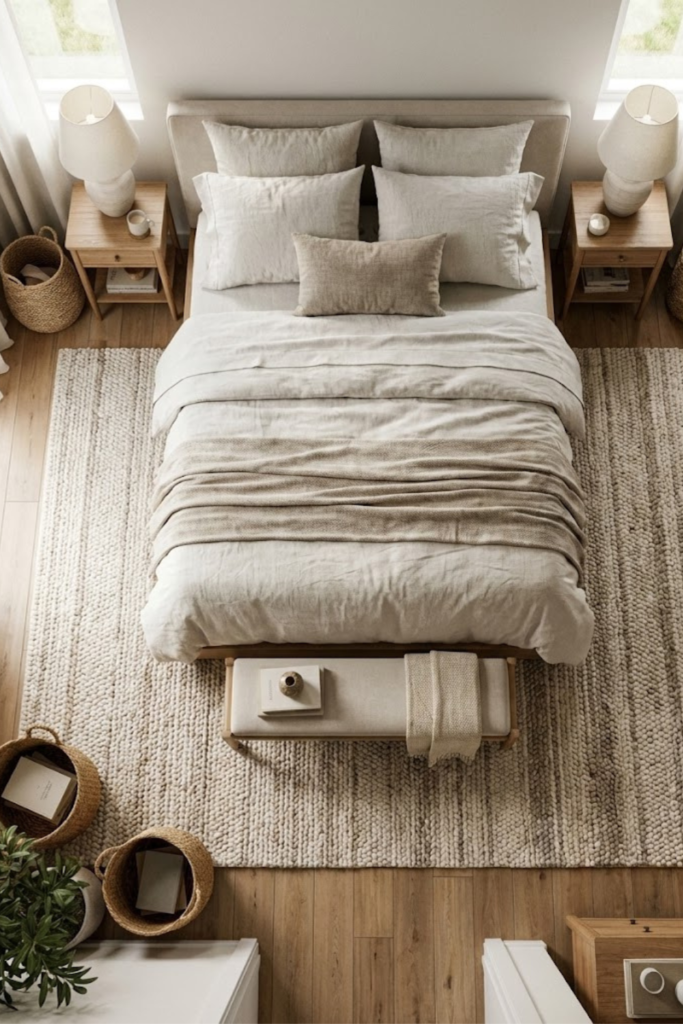
I made a classic mistake in my first apartment. I had a small room, so I thought, “Small room, small rug, right?” It made sense in my head. I went out and bought a little 4×6 rug and plopped it right in the middle of the floor at the foot of the bed.
It looked ridiculous. It looked like a postage stamp floating in the middle of the room. Instead of making the room feel cozy, it actually made it look smaller. It chopped up the floor space visually. I could see the wood floor, then the rug, then the wood floor again. It created too many “zones” in a space that was already tiny. I lived with it for a year before I realized that I had it all backwards.
Go Big or Go Home
Here is the rule that feels wrong but is actually right: in a small bedroom, you need a big rug. I know, it sounds crazy to cover up almost all the floor you have. But here is why it works.
When you put down a large rug—say, an 8×10 or even a 9×12 if it fits—it draws your eye all the way to the edges of the room. It creates one big, unified surface. It tricks your brain into thinking the room is as big as the rug. When I finally swapped that tiny mat for a large area rug that reached almost to the walls, the room suddenly felt expansive. It felt grander, like a hotel suite instead of a dorm room.
The Placement Strategy
You can’t just throw the rug down anywhere. The placement matters a lot. The best way to do this in a bedroom is to have the rug slide under the bed.
Ideally, you want the rug to start about a foot or two in front of your nightstands. It should run under the bed and stick out on the sides and the foot. When you get out of bed in the morning, your feet should land on the rug, not the cold floor. This anchors the bed. If the rug is floating in the middle of nowhere, the furniture feels like it is drifting. Anchoring it makes the room feel settled and calm.
Texture is Your Friend
Since we are talking about 2026 trends, let’s talk about texture. Smooth, flat rugs are okay, but right now, it is all about feeling cozy. I love a rug with some bumps and lumps—in a good way! Think about a chunky wool loop or a soft jute blend.
In a small room, you don’t have space for a lot of decor items without it looking cluttered. So, the floor is a great place to add interest without taking up space. A textured rug adds warmth and character. Plus, it helps with sound. Small rooms can get echoey. A thick, textured rug absorbs the sound and makes the room feel quiet and peaceful, which is exactly what you want when you are trying to sleep.
Conclusion: Embracing the Cozy Life
We have covered a lot of ground here. If you are sitting there looking at your small bedroom and feeling a bit overwhelmed, take a deep breath. You don’t have to do all seven of these things this weekend. In fact, please don’t. You will drive yourself crazy. Design is a slow process, not a race.
I spent years hating my small spaces before I realized that a small bedroom is actually a blessing in disguise. Think about it. A huge bedroom can feel drafty and empty. It takes a lot of furniture to make it feel lived-in. But a small room? It is halfway to being a cozy sanctuary just by existing. You are already in the “cocoon” phase; you just need to polish it up a bit.
The “Edit” is Hard but Necessary
Before you go out and buy that giant rug or those wall sconces, I have one last piece of advice. You have to edit your stuff. I know, nobody likes to hear this part. I am a bit of a hoarder myself. I love keeping old ticket stubs and magazines. But in a small room, clutter is the enemy.
If you have clothes you haven’t worn in two years, donate them. If you have books on your shelf that you didn’t like and won’t read again, give them to a friend. You have to be a bit ruthless. The ideas we talked about—like color drenching and vertical storage—only work if the room isn’t bursting at the seams with junk. Clear the canvas first, then start adding the pretty stuff.
Start Small
If I were you, I would pick just one thing from this list to try first. Maybe this Saturday, you just swap out the big table lamp for a wall light. Or maybe you just spend an hour moving your curtain rod up to the ceiling.
You will be surprised how much one little change shifts the energy of the room. It creates momentum. Once you see how good that one change looks, you will want to do the next one.
You’ve Got This
Remember, your home is for you. It isn’t a museum and it isn’t a showroom. It is where you recharge your batteries. Don’t worry about what is “trendy” if you don’t like it. If you hate sage green, don’t paint your room sage green just because I said it is popular in 2026. Pick a color that makes you feel happy when you wake up.
I hope these tips help you see your small bedroom not as a problem to be solved, but as a little jewel box waiting to shine. You have the tools now. Go make it beautiful.
Found this helpful? Pin this to your “Small Bedroom Ideas” board on Pinterest so you don’t lose these tips!