Home isn’t just a place, it’s a feeling.” We’ve all heard it, but does your space actually feel like a warm hug when you walk through the door? In the fast-paced digital world of 2026, the need for a sanctuary has never been more pressing! We aren’t just decorating; we are curating “cocooning” environments that shelter us from the noise. Whether you are working with a sprawling living room or a tiny studio apartment, the principles of coziness remain the same: warmth, texture, and a touch of soul.+1
I remember staring at my own cold, gray walls a few years ago, feeling like something was missing—it wasn’t furniture, it was heart. That’s when I discovered the power of “warm minimalism.” It’s not about clutter; it’s about choosing pieces that speak to you. In this guide, we are diving deep into 7 cozy room ideas that blend modern trends with timeless comfort. Get ready to swap the stark white for terracotta tones and the rigid lines for organic curves. Let’s make your home the coziest place on earth!
1.Embrace Warm Minimalism with Textural Layering

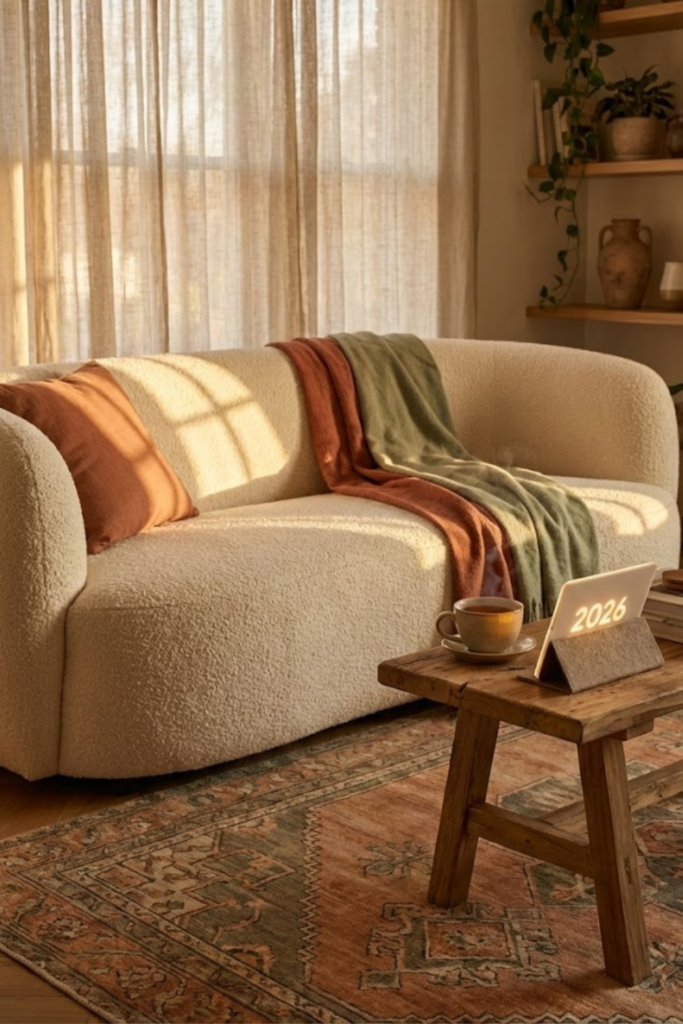
You know, a few years back, I went through this intense phase where I wanted everything in my house to be stark white. I thought it was the height of sophistication. Spoiler alert: it wasn’t. It actually felt like living in a dentist’s waiting room. I’d come home from a long day of teaching, drop my bag, and just feel… colder. The echo in the living room was real, and honestly, it was a bit depressing. That’s when I finally stumbled onto the concept of warm minimalism, and it completely changed how I look at cozy room ideas.
It turns out, you don’t need a cluttered room to feel cozy. You just need to stop obsessing over empty surfaces and start caring about how things feel.
Why Texture Beats Clutter Every Time
The biggest mistake I made was thinking that “clean lines” meant “hard surfaces.” I bought this sleek, glossy coffee table that looked great in the catalog. But in real life? It was a nightmare of fingerprints and glare. It added zero warmth.+1
To fix it, I didn’t throw the table out. I just added a rough, woven runner and a ceramic bowl with an imperfect finish. Suddenly, the room had a pulse again.
Warm minimalism is all about that contrast. It’s the art of mixing materials so your eyes have something interesting to land on, without being overwhelmed by stuff. If you have a smooth leather sofa, you shouldn’t pair it with smooth silk pillows. That’s too much slip and slide! Throw a chunky wool blanket on there instead. The friction creates the cozy factor.+1
My “Rule of Three” for Fabrics
I’ve messed up a lot of rooms before I figured this out. Now, whenever I’m styling a space, I use what I call the “Rule of Three” for textural layering. It’s a simple trick I stick to.
- Something Soft: This is your velvet, fleece, or boucle.
- Something Rough: Think jute rugs, raw wood, or linen.
- Something Shiny: Just a touch of brass, glass, or glazed ceramic.
When I finally applied this to my bedroom, mixing a linen duvet (rough) with a velvet headboard (soft), the vibe shifted instantly. It went from “dorm room” to “sanctuary.”
Don’t Fear the Matte Finish
Another thing I learned the hard way is that shiny things are often the enemy of cozy. In 2026, we are seeing a huge shift toward matte finishes for a reason. They absorb light rather than reflecting it, which creates a softer, quieter atmosphere.
I remember painting a wall with a semi-gloss because I thought it would be easier to clean. It just looked plastic. I repainted it with a flat, limewash-style paint, and the difference was wild. The walls looked like velvet. It felt like the room was hugging me.
If you are trying to nailing this home decor trend, start small. Swap out a glossy vase for a terracotta one. It’s a cheap fix, but it grounds the space immediately.
A Note on Rugs (My weakness)
I have a bit of a rug obsession. But here is the thing: one rug is good, but two is better. This is a classic move for textural layering.
In my living room, I have a large, inexpensive jute rug that covers most of the floor. It’s durable, but not exactly soft on the toes. So, I layered a smaller, fluffy faux-sheepskin right where my feet land when I sit on the sofa. It looks curated and expensive, but it’s really just practical comfort.
Don’t worry about it looking perfect. If the top rug is slightly crooked, it just looks lived-in. We aren’t aiming for a showroom here; we’re aiming for a home.
2.Curate a Cocooning Reading Nook

I used to think I didn’t have space for a reading nook. My house isn’t huge, and every corner seemed full of clutter or kid stuff. But honestly, I just needed a place to hit the “pause” button. After a long day of grading papers, sitting on the main couch with the TV blaring wasn’t cutting it. I needed a spot that signaled to my brain (and my family), “I am off the clock.”
So, I cleared out a weird, empty corner by the window, and it became my favorite spot in the house. You don’t need a library to do this. You just need a few square feet and the right mindset.
The “Hugging” Chair
The chair is the most important part. Don’t just drag in a dining chair and call it a day. You need something that feels like a warm hug.
When I was looking for mine, I sat in about twenty different chairs at the furniture store. I probably looked crazy, just closing my eyes in each one. I ended up with a high-back armchair with deep seating. The high back is key because it physically blocks out the sight of the dirty dishes in the kitchen. It creates a little shield. If you can, get a footstool or an ottoman, too. Putting your feet up changes the whole vibe from “sitting” to “lounging.”
Lighting That Doesn’t Hurt
Here is a tip I tell everyone: turn off the big light. Overhead lighting is the enemy of cozy room ideas. It’s too bright and makes you feel like you’re in a grocery store.
For my nook, I bought a cheap floor lamp with a swing arm. It lets me direct the light right onto my book pages. But the real trick is the lightbulb. I swapped the standard bulb for a “warm white” one—look for 2700K on the package. It gives off a golden, candlelight glow that instantly calms you down. It’s hard to stay stressed when the light is that soft.
The “Don’t Make Me Get Up” Table
This sounds lazy, but it’s practical. You need a tiny side table right next to your chair.
Why? Because if you settle in with a hot cup of tea and a book, but you have nowhere to set the mug down, you have to get up. And once you get up, you see a toy on the floor, or you remember you need to start laundry, and the moment is gone. Keep a small table within arm’s reach. I keep my current book, a coaster, and my reading glasses there. It’s my little command center for relaxation.
Creating Soft Boundaries
Since my nook is technically in the living room, I needed a way to separate it from the chaos. I didn’t want to build a wall, so I used a “soft boundary.”
I put a tall, leafy plant (a fake Ficus, because I kill real ones) right between my chair and the rest of the room. It acts like a screen. When I’m in the chair, I see leaves, not the TV. You could also use a folding screen or even a hanging macrame divider. It just helps to create a “room within a room” feeling without any construction.
3.Soften the Space with Biomorphic Furniture
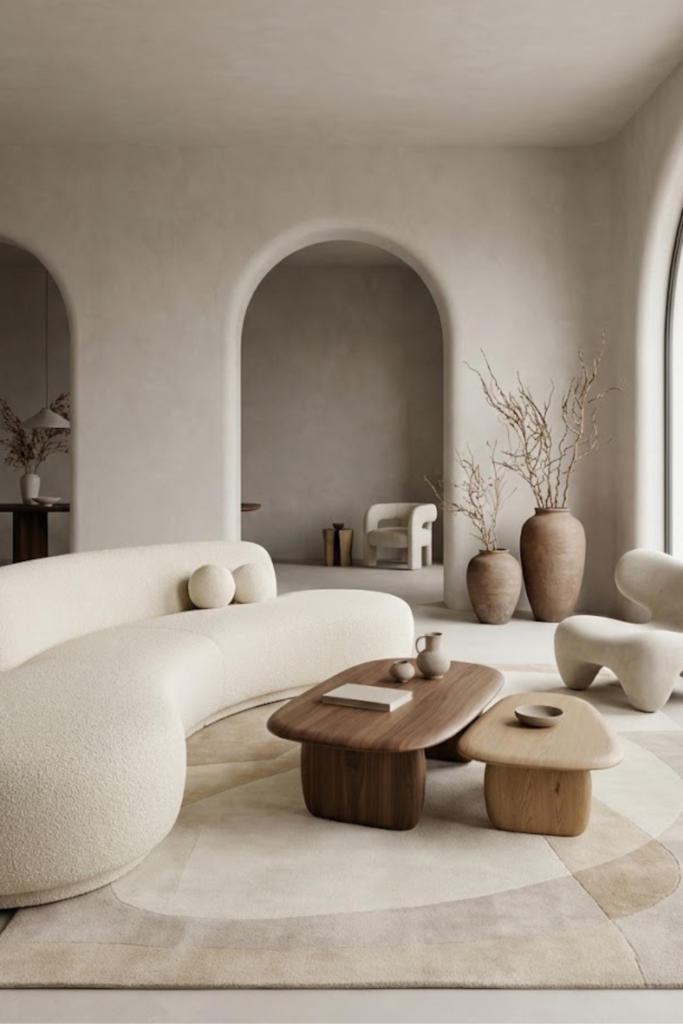
I remember buying this super modern, rectangular glass coffee table in my 20s. It looked cool, but my shins hated it. Every time I walked by, I was practically dodging a sharp corner. Now that I’m older, I realized my house was full of straight lines. The TV, the windows, the doors, the rug—everything was a square or a rectangle. It felt a bit rigid, you know?
That’s when I started hearing about biomorphic furniture. It’s a fancy word, but it really just means “shapes that look like nature.” Think about it: nature doesn’t really do straight lines. Rivers curve, trees twist, and stones are round. Bringing those shapes inside makes a room feel less like a box and more like a living space.
Why Curves Feel Safer
There is actually some science behind this. Our brains see sharp corners and think “danger,” even if we don’t realize it. Curves signal safety.
I swapped my boxy sofa for one with a slight curve to it—kind of a kidney bean shape. It wasn’t cheap, but it totally changed how we sit. Instead of everyone facing forward like we’re on a bus, the curve turns us slightly toward each other. It’s way better for chatting. Plus, visually, it flows. It makes the room look less stiff.
Start with the Coffee Table
If a new couch is too expensive (I get it, teacher salary here), start with the coffee table. This is the easiest swap.
Get rid of the sharp corners. I found a wooden table shaped like an oval pebble at a thrift store. It adds this organic feel that breaks up all the boxy lines of the room. And honestly, it’s safer. No more bruised knees when I’m rushing around in the morning trying to find my keys. Using organic coffee tables made of wood or stone grounds the room in a way that glass or metal just can’t.
Fake the Architecture with Mirrors
Most of us are stuck with square windows and rectangular doors. We can’t easily change that. But you can cheat with decor.
I hung a big arched floor mirror in my hallway, and it tricked the eye. It softens the hard vertical lines of the walls. You can even do this with smaller decor. I have this lumpy, clay lamp base that looks like someone made it by hand (badly, maybe). It’s not perfect, but that’s the point. The imperfections make it feel real and cozy, not like it came out of a factory robot.
4.Infuse Warmth with Terracotta and Earth Tones

I went through a long phase where I painted everything in my house “Agreeable Gray.” It was safe, sure. But looking back, it felt a little bit… chilly? It didn’t have much soul. In 2026, we are finally seeing the end of the all-gray house. Thank goodness. The “Terracotta Renaissance” is here, and I am fully on board.
Color is the quickest way to change how a room feels. If you want cozy room ideas, you have to look at the color wheel. Cool colors (blues, stark whites) pull away from you. Warm colors (oranges, browns, yellows) come toward you. They literally make a large room feel smaller and more intimate.
The Earthy Palette Switch
You don’t have to paint your whole house orange. Please don’t do that. It’s about adding warmth in small doses.
I started by swapping out my cool blue throw pillows for ones in burnt orange and sage green. Immediately, the living room felt more grounded. These “earth tones” remind us of the outdoors—mud, clay, leaves. It makes us feel rooted. If you are scared of color, try “warm ochre.” It’s basically a dark, muddy yellow that looks amazing with wood furniture.
The “Jewel Box” Effect
If you are feeling brave, try painting just one wall. But don’t pick a bright, screaming color. Pick a deep, moody earth tone.
I painted the wall behind my bed a deep, rusty red color. My friends thought I was crazy until they saw it. It created this “jewel box” effect. The room feels darker, yes, but in a good way. It feels like a cave (the nice kind). Some people even paint the ceiling the same color to really close the space in. It sounds scary, but it’s actually super relaxing for sleeping.
Ceramics and Wood
If you are renting and can’t paint, focus on what you put on the shelves.
I started collecting unglazed terracotta pots. The texture is rough and dry, which contrasts really well with soft curtains. They add that raw, rustic look that is huge right now.
Also, look at your wood furniture. For a long time, bleached, pale wood was the trend. But for a cozy vibe, medium-to-dark wood tones are better. I found a second-hand walnut side table, and the dark wood adds a richness that my old white IKEA tables never had. It anchors the room.
5.Master the Art of Mood Lighting
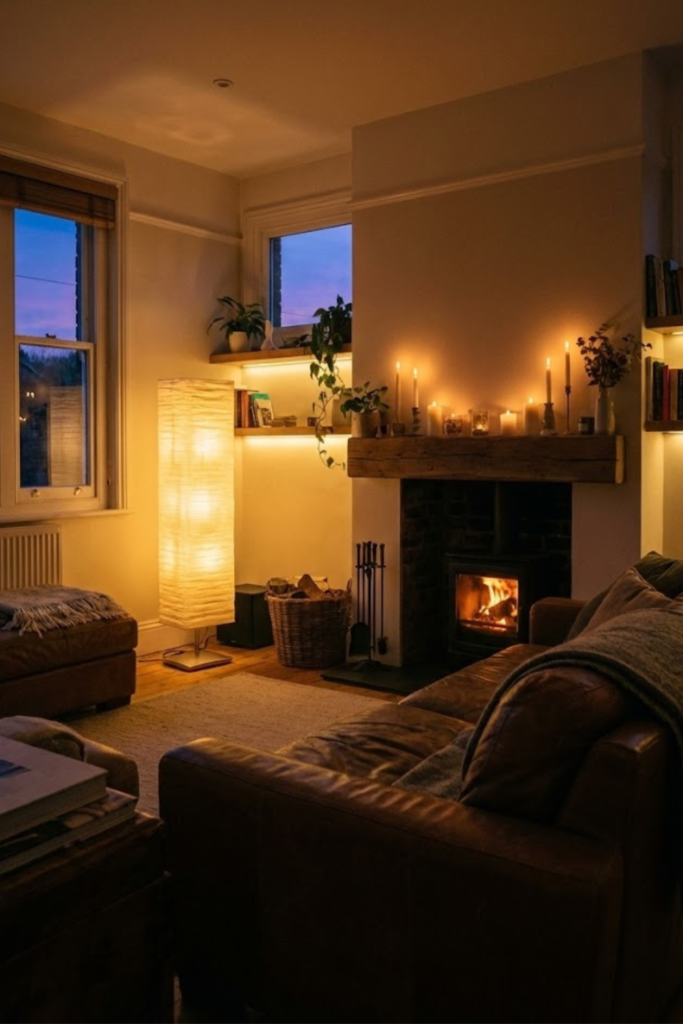
In my house, we have a strict rule after 8 PM: the “big light” does not go on. You know the one—the main overhead light in the center of the ceiling. My kids call it “the interrogation light.” It’s bright, it casts weird shadows under your eyes, and it completely kills the cozy vibe.
Lighting is honestly the most important part of mood lighting tips. You can have the softest blankets in the world, but if you are sitting under a harsh, flickering fluorescent bulb, you won’t feel relaxed. The goal is to create pools of light, not to flood the whole room.
Layer Your Light Sources
I learned that a room needs layers. Just like an outfit. I used to just rely on the ceiling fixture, but now I focus on “low-level lighting.”
This means lamps. Lots of them. I have floor lamps in the corners and table lamps on the side tables. The light should be at eye level or below when you are sitting down. This creates a much softer glow that feels like a campfire. It stops your eyes from straining. If you walk into my living room at night, it looks a bit moody, but that’s the point. It signals to your body that the day is done.
The Magic Number: 2700K
Here is a specific technical tip that changed my life. When you buy lightbulbs, don’t just grab the cheapest box. Look at the side of the package for the “Kelvin” or “K” number.
- 5000K: This is “Daylight.” It’s blue and harsh. Avoid this for living rooms.
- 3000K: This is “Bright White.” Good for kitchens, but still a bit crisp.
- 2700K (or lower): This is “Warm White.” This is the sweet spot.
I switched all my living room and bedroom bulbs to 2700K or even 2400K. It gives off that golden, amber light that looks like candlelight. It makes everyone look better, and it helps your brain release melatonin so you can sleep better later.
Dimmers Are Your Best Friend
I am not an electrician, but swapping a regular light switch for a dimmer switch is actually pretty easy. I watched a video online and did it myself (after turning off the power at the breaker, obviously!).
Being able to dim the lights is a game changer. Sometimes you need bright light to find a lost earring, but most of the time, you only need about 50% power. Lowering the lights instantly makes a room feel warmer and more intimate.
Hidden Glows
One new thing I tried this year was using LED strips. I know, it sounds a bit like a teenager’s gaming room, but hear me out.
I stuck a warm-white LED strip behind the headboard of my bed. When I turn it on, it washes the wall in a soft light without shining in my eyes. It’s perfect for reading or just winding down. You can also put them under kitchen cabinets. It adds depth to the room without adding clutter.
6.Bring the Outdoors In with Biophilic Accents

I honestly used to kill every plant I touched. My students once gave me a succulent for Teacher Appreciation Week, and it was brown within a month. I felt so bad! But I kept trying because I noticed something: whenever I walked into a room full of plants, I just felt… better. My shoulders dropped. I breathed deeper.
It turns out there is a name for this. It’s called biophilic design. It sounds fancy, but it just means humans like nature. We are wired for it. Bringing a bit of the outdoors inside isn’t just about looks; it actually lowers your stress. And in 2026, we all need a bit less stress, right?
One Big Tree beats Ten Small Ones
For a long time, I bought those tiny little pots from the grocery store. I had them lined up on my windowsill, and it looked cluttery. Plus, watering them all was a pain.
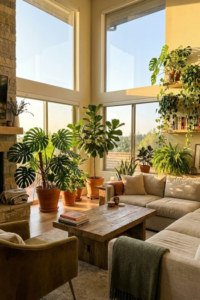
Then I saved up and bought one large Ficus tree. Just one. I put it in the corner of the living room in a nice basket, and wow. It completely changed the room. It created a “canopy” effect. It felt like sitting under a tree in the park. If you want cozy room ideas that pack a punch, stop buying the baby plants. Go for one big “statement tree.” An Olive tree is another good pick if you have enough light.
Wood, Cane, and Rattan
Biophilic design isn’t just about green stuff. It’s about materials, too.
I looked around my house and realized I had a lot of plastic and metal. It felt cold. So, I started swapping things out. I got a side chair with a cane back and a rattan basket for my blankets. These natural materials add texture that you just can’t get from synthetic stuff. They are imperfect and rough, which makes the room feel warmer. Even a cork bulletin board in my home office helped soften the vibe.
Look Up: Greenery Ledges
I ran out of floor space pretty quickly (thanks to the dog), so I had to get creative. I installed a high shelf right near the ceiling.
I put a Pothos plant up there—you know, the ones that grow like crazy vines? I let the vines trail down the wall. It draws your eye up, making the ceiling feel higher, but it also softens the hard corner of the room. It’s like living wallpaper. And the best part? The Pothos is super hard to kill. If I can keep it alive, you can too.
Nature Art for the “Black Thumbs”
If you really, truly cannot keep a plant alive, that is okay! You can still cheat.
I hung a large print of a misty forest landscape over my sofa. It’s not real nature, but my brain doesn’t seem to care. It still gives me that calm feeling of looking at a view. You can also frame pressed flowers or botanical prints. It brings that organic shape into the room without the need for watering can reminders.
7.Personalize with Nostalgic “Grandmillennial” Touches

For the longest time, I tried to hide the things I inherited from my grandmother. I thought her old floral plates and brass candlesticks were “dusty” and old-fashioned. I wanted everything to look brand new, like a page out of a catalog. But you know what? My house ended up looking like everyone else’s. It was boring.
Then I heard about this style called “Grandmillennial” or “Granny Chic.” It’s basically a fancy way of saying “cool vintage stuff.” In 2026, this is huge. We are all craving a bit of history and comfort. A truly cozy room needs to tell a story, specifically your story.
The Magic of Vintage Rugs
I saved up for a while to buy a vintage Turkish rug, and it is hands down the best thing I own.
Here is why: it’s already worn in. When my kid spilled juice on it, I didn’t even cry. The pattern was so busy and faded that you couldn’t even see the stain. That is the kind of cozy room ideas I love—stuff that looks good but works for real life. A faded Persian rug adds instant warmth and color to a plain floor. It makes the room feel like it has been there forever, not just set up yesterday.
Display Your Treasures (Not Store-Bought Filler)
I used to buy those generic art prints from big box stores just to fill up empty wall space. You know, pictures of random leaves or cities I’ve never visited.
I took them all down. Instead, I made a “gallery wall” of stuff that actually matters. I framed a postcard from a trip I took in college. I put up a black-and-white photo of my parents. I even hung up a weird little wooden mask I found at a flea market. Now, when people come over, they actually look at the wall and ask questions. It’s a conversation starter.
Mix Your Patterns
This part scared me at first. I thought you couldn’t mix stripes with florals. I was wrong.
The trick to the “Granny Chic” look is that it shouldn’t match perfectly. I have a plaid throw blanket on a chair with a floral pillow. It sounds messy, but if the colors are sort of similar, it works. It looks “collected.” It looks like a home that grew over time. Don’t be afraid to mix it up. If it looks too perfect, it looks like a hotel.
The Thrill of the Thrift
My favorite weekend hobby now is hitting the local thrift store. You can find such cool stuff for like, five dollars.
I look for heavy brass candlesticks, wooden bowls, or old ceramic pitchers. These things have weight and texture. They feel real. Putting a beat-up wooden bowl on your coffee table adds way more character than a shiny plastic one. Plus, it’s cheap! You don’t have to spend a fortune to make your home feel special.
Conclusion
So, there you have it. We covered a lot of ground, didn’t we? From throwing chunky blankets on everything to finally turning off that terrible overhead light.
Transforming your home into a cozy sanctuary isn’t about following a strict set of rules or spending all your savings. It’s really just about layering things that make you feel safe, grounded, and happy. It took me years to figure out that my house didn’t need to look like a showroom; it just needed to feel like me.
I hope these cozy room ideas gave you a little spark of inspiration. Maybe you will go thrift shopping this weekend for a vintage rug, or maybe you will just finally move that chair into the corner for a reading nook. Whatever you do, don’t stress about making it perfect. The most stylish home in 2026 is one that looks lived-in and loved.
If you found this helpful, do me a huge favor! Pin this article to your “Dream Home 2026” board on Pinterest so you can find it later. Happy decorating!